Villa vs Luxury Hotel: How to Choose for Your Trip
Villa or luxury hotel? Compare privacy, space, service, true cost and trip length, and see which suits a culture-led journey with complex plans.
Published
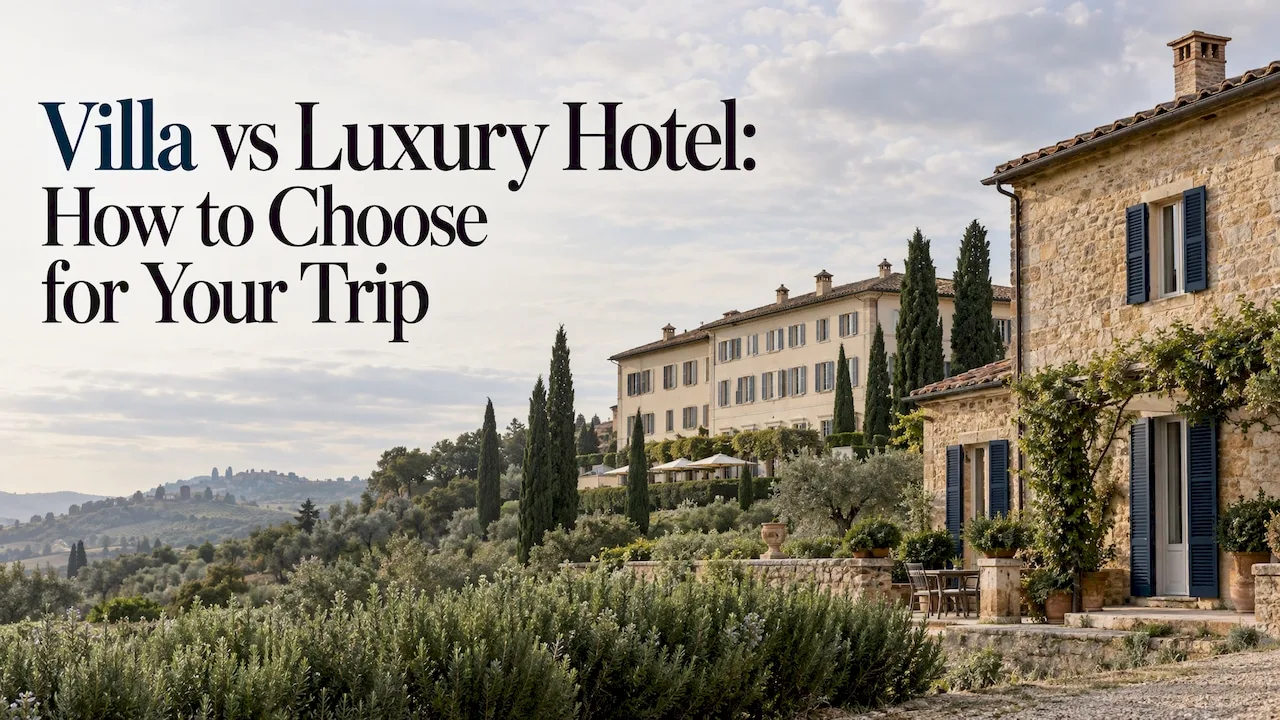
A luxury hotel gives you a room inside a well-run building. A villa gives you the whole building, with its own pool, kitchen and quiet. Neither is better in general. The right choice depends on how long you stay, who travels with you, and how much of the trip happens away from the property. For culture-led journeys with private visits, guides and tight timings, the accommodation should serve the itinerary rather than the other way around, which is why we decide it during travel design, not after the flights are booked.
Key Takeaways
- Choose a villa for privacy, space and control over your own schedule, especially for families, multi-generational groups and stays of four nights or more.
- Choose a luxury hotel for short stays, city breaks and trips where on-demand service, a concierge and a walkable location matter more than space.
- Compare the total bill, not the nightly rate: staff, meals, transfers, taxes and service charges change the picture in both directions.
- On a culture-focused trip, location and logistics matter more than square footage. Sleep where the day’s appointments are easiest to reach.
- A hybrid itinerary, hotel in the city and villa in the countryside or on the coast, often beats either one alone.
What actually separates a villa from a luxury hotel
The cleanest way to put it: a hotel is a service platform with rooms attached, and a villa is a private home with services attached.
A luxury hotel offers larger rooms and suites, premium bedding, a concierge desk, restaurants, a spa and a front desk that answers at any hour. You share the pool, the lobby, the lifts and the breakfast room with other guests, and the experience is consistent from the moment you check in.
A villa is a private residence rented to one group. It typically has several bedrooms, a living room, a kitchen and often a pool and garden that nobody else uses. At the top end, a villa is not a bare house. Luxury Travel Report describes the best of them as curated, fully serviced residences with chefs, butlers, housekeepers and concierge teams who pre-arrange transfers and excursions, so the stay feels like a boutique hotel built for one party.
Two other terms come up in the same searches:
- Resort: a large property that contains its own restaurants, pools, activities, children’s clubs and often a beach or golf course. You can spend a week without leaving. Variety and infrastructure are the product.
- Boutique hotel: a small property, usually under 100 rooms, with personal service and a distinct design. It sits between a grand hotel and a villa in scale and often wins on location.
A mansion and a villa are not the same thing. “Villa” describes how the property is rented and run, a private, self-contained stay, and not its architecture. A modest farmhouse and a staffed palazzo can both be villas.
Privacy and space
Space is the most visible gap. A hotel suite is generous by hotel standards, but you are still in one or two rooms. A villa gives you the entire property: separate bedrooms, a living area where the group can gather, a terrace, a garden.
Privacy follows from that. In a villa you do not queue for pool loungers, cross a crowded lobby or hear a neighbor through the wall. Children can be loud, dinner can be at 10 p.m., and nobody sees any of it. Laura Ratliff of Luxury Travel Report makes the same case: groups stay under one roof rather than scattered across resort buildings, and private chefs build menus around individual dietary needs.
Read descriptions closely, though. A “private terrace” at a hotel is not the same as a private outdoor area, and a villa inside a larger resort may share paths, beaches or walls with others. Ask exactly what is yours alone: the pool, the garden, the approach, the view.
Service and dining
This is where the two diverge most in daily life.
Hotel service is continuous. Reception, housekeeping, room service, restaurants and wellness facilities are available on a predictable schedule, and you can ask for something at midnight. If you want a spa with several treatment rooms, a choice of restaurants and a strong concierge, a hotel delivers all of that without any planning.
Villa service is arranged. Housekeeping, a cook or a butler usually work to a schedule agreed in advance, so what you receive depends on what was set up before arrival. The reward is personalization. A private chef shops for what you like, cooks at the hour you choose and works around allergies and preferences. In some destinations a day of private-chef meals can cost less than a single hotel dinner for two, though this varies widely by place and standard.
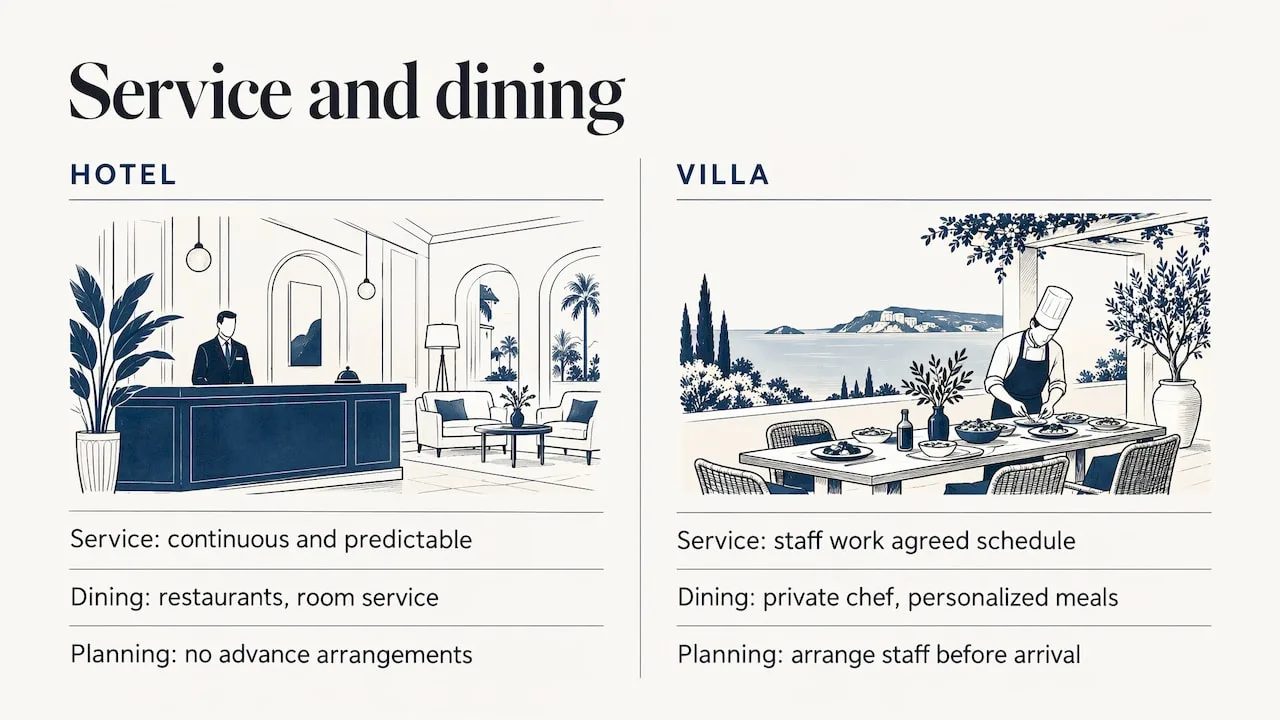
The practical consequence: a villa rewards preparation. The better the arrangements before you land (who meets you, who stocks the kitchen, who handles a broken air conditioner at 9 p.m.), the more the stay feels effortless. That coordination is where a single point of contact earns its place.
What each one really costs
Nightly rates mislead in both directions. A villa can look expensive per night and be economical per person. A hotel can look reasonable until the extras arrive.
What to put on the same sheet when you compare:
| Cost line | Luxury hotel | Private villa |
|---|---|---|
| Base rate | Per room, so a family may need two or three | Per property, regardless of how many sleep in it |
| Meals | Restaurant and room-service prices, sometimes a meal plan | Groceries plus a chef or cook if you want one |
| Staff | Often built into rates or a service charge | Cook, housekeeper, butler or driver may be separate lines |
| Taxes and service charges | Added to the bill in many destinations | Also added, plus possible cleaning or security fees |
| Transfers and excursions | Concierge arranges, you pay | Usually arranged for you, you pay |
| Minimum stay | Rare outside peak dates | Common at peak holidays |
The lesson is to ask for a full, itemized quote on both options, with the same dates and the same people. Rules about showing the full price vary by country, and some destinations add taxes and service charges on top of the printed rate that can lift a bill by a fifth or more, so confirm what the number you are looking at includes.
For a group, the arithmetic often favors the villa. A Tuscan farmhouse for eight shares one rate across eight people, while the equivalent hotel standard means four rooms and a restaurant bill every night. For a couple on a three-night city visit, the hotel usually wins, because you are paying for a property you would barely use. If you want a sense of how rates are built and why they swing by season, this guide on setting vacation rental rates shows what sits behind a villa’s nightly price.
When a villa is the better choice
- Families and multi-generational groups. Grandparents, parents and children each get a bedroom, and nobody has to leave a sleeping toddler to eat dinner. Our guide to planning family private tours covers how this fits around daytime visits.
- Honeymoons and celebrations. A private pool and a chef who cooks for two or twenty make occasions feel personal.
- Longer stays. A villa needs a day to find its rhythm. After that, the slower pace is the point: you stay longer at breakfast and stop planning your day around a hotel’s timetable.
- Food on your terms. If cooking together or eating at home is part of the plan, a kitchen and a chef beat a restaurant schedule.
- Places where the setting is the draw. Countryside, coast and island stays suit a villa, because the surroundings are what you came for.
When a luxury hotel is the better choice
- One or two nights. You get the full benefit of a hotel from the first hour. A villa does not.
- City trips. Villas tend to sit at beaches and in the countryside. In a city, a well-placed hotel puts the museum, the restaurant and the evening performance within walking distance.
- Deep on-site service. If you want a large spa, several restaurants, a gym and a children’s club without arranging any of it, a hotel or resort is built for that.
- Groups with different ideas of a good day. Some will want the spa, some the water park, someone the pool bar by 11 a.m. A large resort lets everyone split up without negotiation.
- A boutique hotel for the culture-minded. A small, design-led property in the historic center suits couples and travelers who want a local, non-corporate feel.
The features that matter for convenience, such as location, check-in method, parking, laundry and kitchen, are worth checking line by line. This list of vacation rental amenities to look for is a useful checklist for the practical details that make a short stay easy.
The culture-focused trip: sleep where the day begins
For travelers whose days are built around landmarks, private openings, specialist guides and timed entries, the question changes. You are not choosing a holiday property. You are choosing a base for a schedule.
Three things decide it.
Distance to the first appointment. A private early-morning visit to a monument is only a pleasure if you are not facing a ninety-minute transfer to reach it. In historic cities, a hotel within a short walk or drive often gives you back an hour on both ends of every day. For a seven-day itinerary, that is the difference between rested and rushed.
How many times you move. Each change of property costs a morning in luggage, check-out and transfers. A villa anchors a region well: one base for a week of day trips across Tuscany or Andalusia. A tour that crosses three cities is better served by hotels, or by a deliberate sequence of stays.
Who handles the unexpected. Tickets, guides, drivers and private-access arrangements all depend on someone making a call when a train is late or an opening time shifts. A hotel concierge can absorb some of that. In a villa, you need someone arranged to do it. Our piece on designing a luxury journey that runs itself explains how we think about that sequencing, and behind-the-scenes tours show why timing and access shape where you should stay.
The hybrid itinerary
Many of the strongest culture trips combine both. Spend the first nights in a city hotel for museums, galleries and dinners within walking distance. Then move to a villa for the second half, with a private chef, slower mornings and day trips to nearby sites. The city gives you access and service; the villa gives you rest and privacy. Italy, Spain and Mexico all lend themselves to this pattern, and our pages on Italy, Spain and Mexico show the kind of places we build journeys around.
A quick way to decide
Answer these five questions honestly.
- How many nights in one place? Four or more points toward a villa; one or two toward a hotel.
- How many people? Six or more usually tips the economics toward a villa. A couple often wants a hotel or a boutique property.
- Where does the day happen? If it happens in a city center, stay central. If it happens at the pool, the table and the garden, choose the villa.
- How much service do you want unprompted? If you want it without arranging it, choose the hotel. If you want it tailored, choose the villa and arrange it ahead.
- How many times will you move? The fewer the moves, the stronger the case for a villa.
Perspective
We plan journeys for people who care about what they see, and they tend to ask about rooms last. That is the wrong order, and it is the one we change.
The property is part of the itinerary. A villa that is two hours from the monument you booked for first light is a poor choice, however beautiful the pool. A grand hotel in the wrong quarter can be just as poor. We start with the days: what you want to see, with whom, and at what pace. Then we choose the bed that makes those days easiest.
This is why we work as a private travel office with a single point of contact. The value of a villa depends on arrangements made before you arrive, and the value of a hotel depends on how well it fits the route. Our approach is built around quiet coordination, so you are not the person solving logistics on holiday.
Our advice is simple. Do not argue villa against hotel in the abstract. Decide what the trip is for, then let the accommodation follow.
Sam
Plan the stay around the journey
If you are weighing a villa against a luxury hotel for a trip built around landmarks, private access and expert guides, our travel design service starts with the itinerary and chooses where you sleep to fit it. Quiet coordination then keeps the arrangements running behind the scenes, with one point of contact for the whole trip.

Tell us the destination, the dates and who is traveling, and we will build from there at Noble Voyages.
FAQ
Is a villa cheaper than a luxury hotel?
Per night, it depends on the property. Per person, a villa is often cheaper for groups, because one rate covers everyone and you can cook or hire a chef. For couples and short stays, a hotel is usually better value. Compare full itemized quotes including meals, staff, taxes and transfers.
What is the difference between a villa and a resort?
A resort is a large property with its own restaurants, pools, activities and sometimes a beach, shared among many guests. A villa is a private residence rented to one group. Choose a resort for variety and on-site infrastructure, and a villa for space and privacy.
Do villas come with staff?
The best ones can. Fully serviced villas offer chefs, butlers, housekeepers and concierge teams, and the service is usually scheduled and agreed in advance rather than available around the clock. Confirm exactly which services are included and which are extra before booking.
Is a boutique hotel more expensive than a luxury hotel?
Not necessarily. A boutique hotel is a small property, typically under 100 rooms, with personal service and a distinctive design, and prices range widely. Its appeal is character and often location, which makes it a good fit for culture-minded travelers.
Which is better for a short city stay?
A hotel, almost always. Service is available from the first hour, and a central location lets you walk to dinner, galleries and performances. Villas tend to sit in countryside and coastal settings and take a day to settle into.