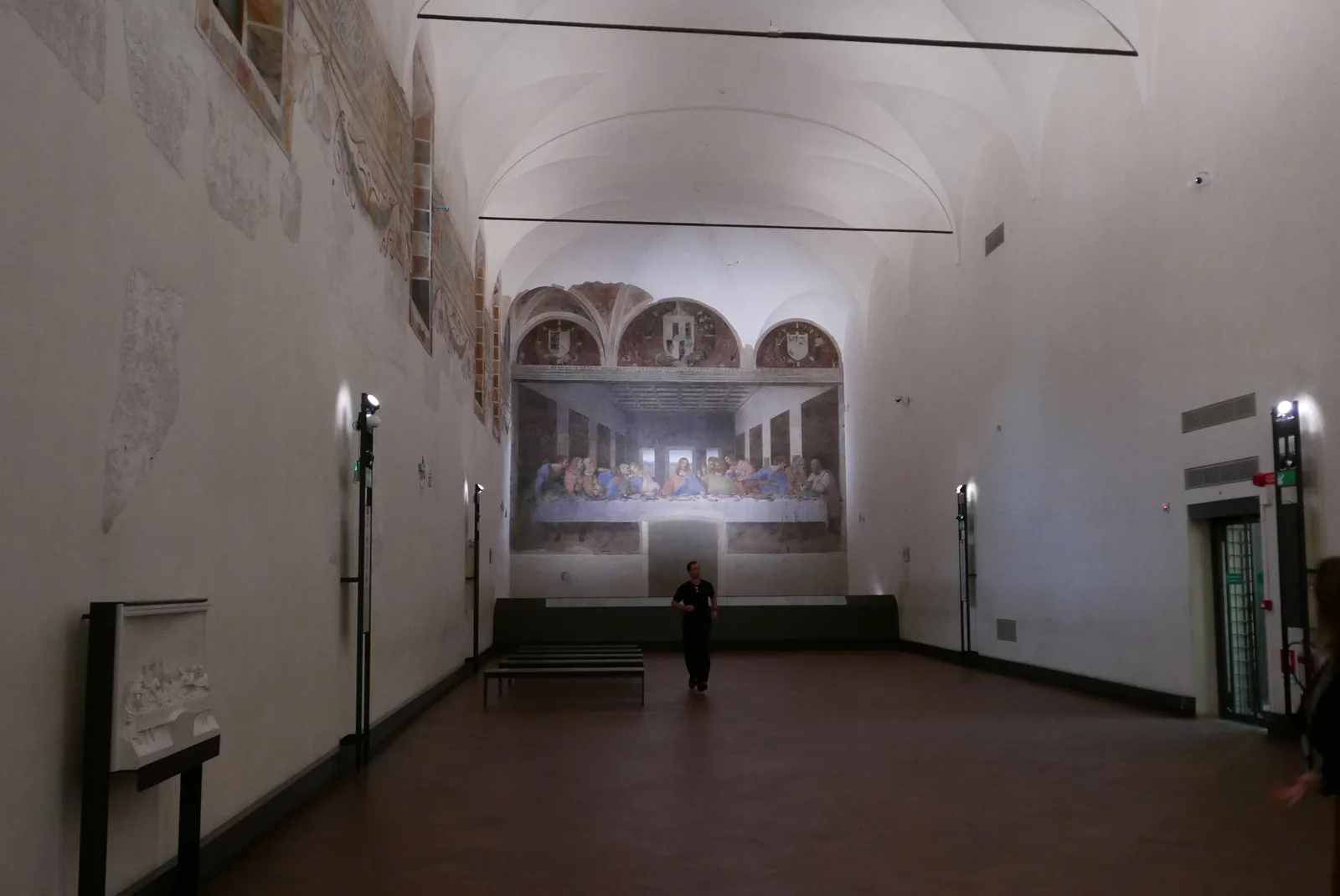
The long view · Milan
Last Supper
History.
A Renaissance experiment in a Dominican dining room, shaped by courtly ambition and centuries of fragile survival.
The refectory · photography credits
01 / The room came first
A refectory at Santa Maria delle Grazie
Before it became a destination for visitors, this was the refectory of a Dominican monastery: a communal room where friars ate, prayed and meditated. Leonardo’s painting fills the north wall, facing the place where the community shared meals. Its subject is therefore not an accidental decoration; the biblical supper enters into conversation with the friars’ own daily table.
The route through the museum preserves glimpses of the larger monastic complex but cannot fully restore its historic everyday life. Corridors, remnants of earlier decoration and the cloister help orient the work: this mural began as part of a living religious institution, not as an isolated masterpiece for a museum gallery.
Milan, near the turn of a century
The painted supper is bound to a real place of supper.
Ludovico Sforza, known as Ludovico il Moro, cultivated an ambitious Milanese court and invested in Santa Maria delle Grazie as a monumental religious complex and family project. Leonardo had arrived in Milan in 1482 and worked for the Sforza court in several capacities.
The museum’s history places the commission within this wider programme: Ludovico entrusted Leonardo with a painting of Christ at the Last Supper for the refectory. The commission connects the artist’s intense study of human expression with the patron’s effort to shape Milan’s religious and political identity.
02 / A scene held in balance
Leonardo’s dramatic geometry
The official museum record dates the work to 1495–1498 and identifies its technique as dry wall-painting. At the centre, Christ anchors the perspective and the emotional focus. The apostles are arranged in four groups of three; news of betrayal animates the scene in a sequence of hands, turned heads and changing expressions.
Leonardo makes a still image feel like a moment unfolding. Each group has its own rhythm, yet the architecture draws them back toward the centre. The painted room appears to continue the real refectory, giving the viewer a place at the threshold of the scene rather than the distance of a conventional framed picture.
The museum notes that the painting was made using a dry technique, not a straightforward wet-fresco process. That approach gave Leonardo scope to work and rework detail, but the wall and its paint proved vulnerable. The artwork’s physical history is inseparable from its famous visual invention.
03 / Damage, care & access
A masterpiece that needs a controlled room
Environmental and material fragility now shape the visit. The museum explains that conservation requires optimal environmental conditions and controlled access; it limits the time visitors spend in the refectory. Those controls are part of caring for the painting, not an obstacle designed around a conventional gallery visit.
There is no need to reconstruct every episode of deterioration to understand what is at stake. The visible work is the result of centuries of exposure, interventions and conservation. The Cenacolo’s research and restoration programme is the primary source for ongoing care; its official conservation and restoration projects offer a deeper account.
For the exact current entry sequence and viewing rules, consult the museum’s visitor information . Then read our practical guide to the visit and the Cenacolo Vinciano overview. The museum’s own artwork record is the reference for the date and medium.
The history ends at the threshold
Prepare your own encounter.
Primary sources: Cenacolo Vinciano museum history; official record for Leonardo’s Last Supper; and museum restoration and research projects.