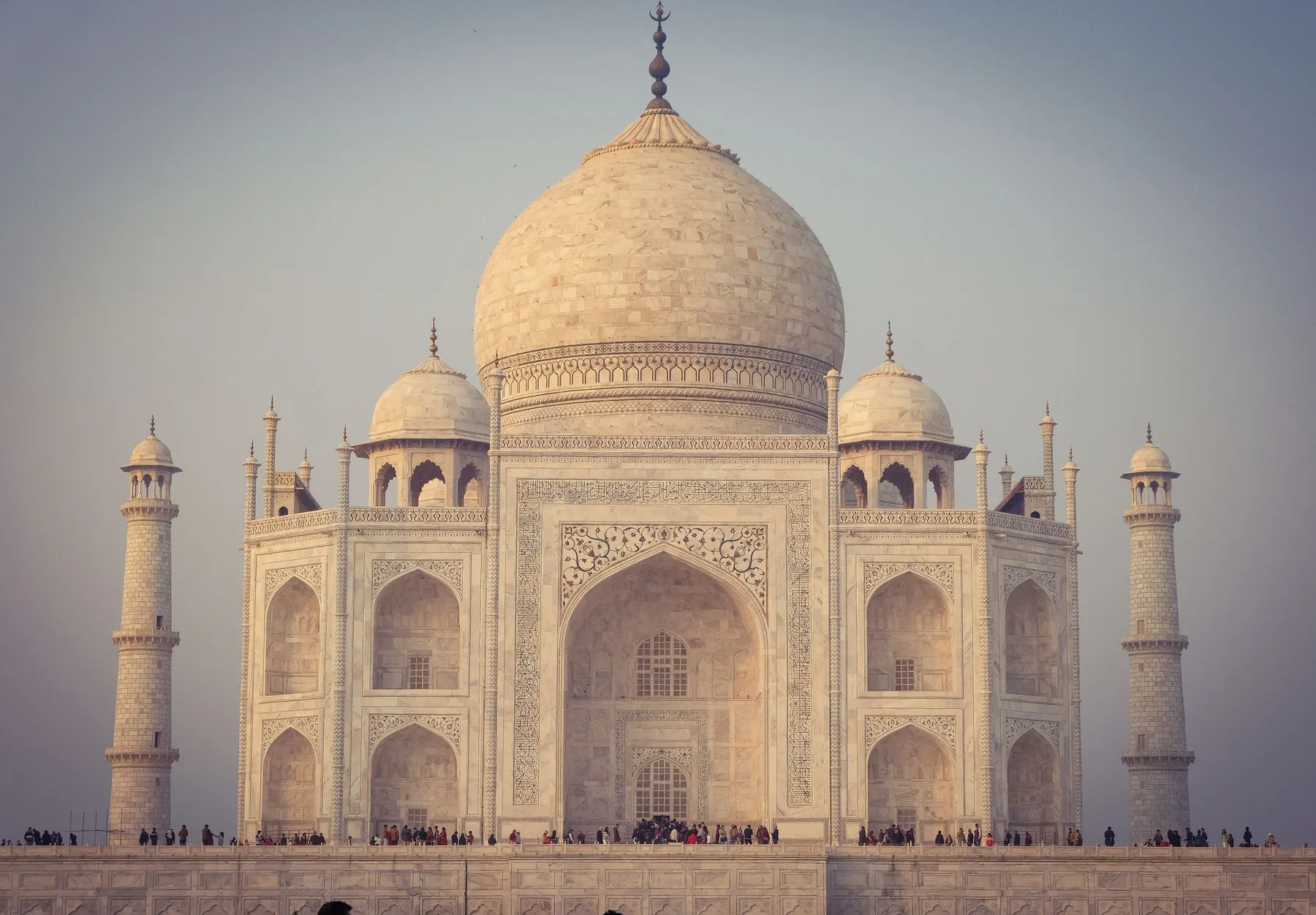
The story in the stone
The Taj Mahal
through time.
A memorial to one person became one of the world's most studied architectural compositions.
01 / A commission of remembrance
Mumtaz Mahal and Shah Jahan.
The Mughal emperor Shah Jahan commissioned the Taj Mahal after the death of his wife Mumtaz Mahal in 1631. Construction began in the seventeenth century, drawing on skilled builders and artisans to create not just a tomb, but a carefully ordered complex beside the Yamuna in Agra.
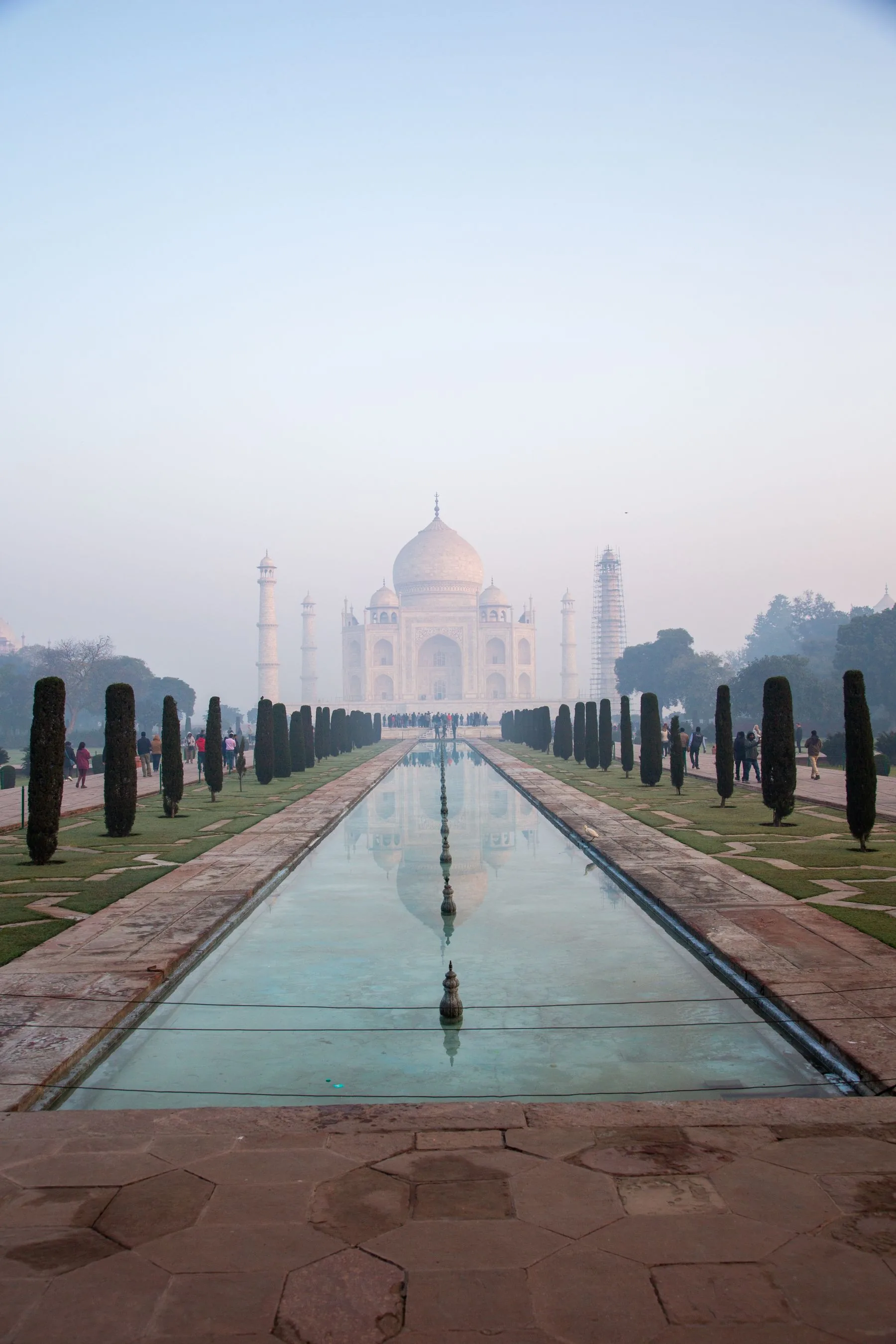
Its fame can obscure its original purpose. At its center is a mausoleum, but the approach through gates, garden and pool is integral to how it is seen. The building's meaning is inseparable from its setting and the act of moving toward it.
For the broader experience of the site, begin with our Taj Mahal overview.
The architecture
The closer you come, the more the symmetry gives way to workmanship.
02 / A measured composition
The garden is part of the design.
A long central watercourse guides the eye toward the marble mausoleum. Flanking structures and the formal garden reinforce the balance of the ensemble, while the river gives the rear of the monument a different edge. It is easy to read the Taj as a singular building; it is more revealing to read it as a sequence of spaces.
On the mausoleum, carved detail, calligraphic bands and stone inlay reward a slower look. Precious and semi-precious materials were worked into the marble in floral forms. The monumental scale and the fine surface craft are meant to be encountered together.
UNESCO's listing places the Taj Mahal among the great achievements of Mughal architecture. The site remains a living place of visitation rather than an image frozen in its original century.
03 / Seeing it today
Take the long view first.
Begin from the garden to understand the full geometry, then approach the marble to see what the distant view cannot show. If you want interpretation on site, ask for a government-approved guide identity card and compare the guide service separately from monument admission.
Our visitor information covers current-rule checks, while the guided visit comparison explains what to ask before paying. For another perspective on the Mughal world, see the Taj Mahal and Agra Fort itinerary.
Continue exploring
Independent editorial guide · Updated 27 September 2026 · Sources: UNESCO World Heritage Centre and official travel-guide advice.