The long view · Vienna
Schönbrunn
History.
A name that begins with a spring, a hunting estate reshaped into a court, and a palace whose gardens were part of its politics.
01 / Before the summer residence
The Katterburg estate
The story starts with a landscape and an estate, not with the palace we recognize today. Schönbrunn’s official history traces buildings on the site to the Middle Ages. In the fourteenth century the estate was known as Katterburg, and by the mid-sixteenth century it had become a country property connected with the Habsburgs. In 1569, Emperor Maximilian II acquired it, extending its use as a hunting ground.
The present name is traditionally linked to a “fair spring”—schöner Brunnen—that Emperor Matthias is said to have encountered while hunting. The palace authority presents this as a legend, and it is best read as an origin story rather than as a documented naming event. The distinction matters here: Schönbrunn grew from a working estate, managed land and successive buildings before it became an imperial showpiece.
Its location just beyond the historic city gave the court space to retreat, hunt and entertain. Over generations, those uses left more than a residence: they laid the ground for an estate in which palace, formal gardens and leisure landscapes would be designed together.
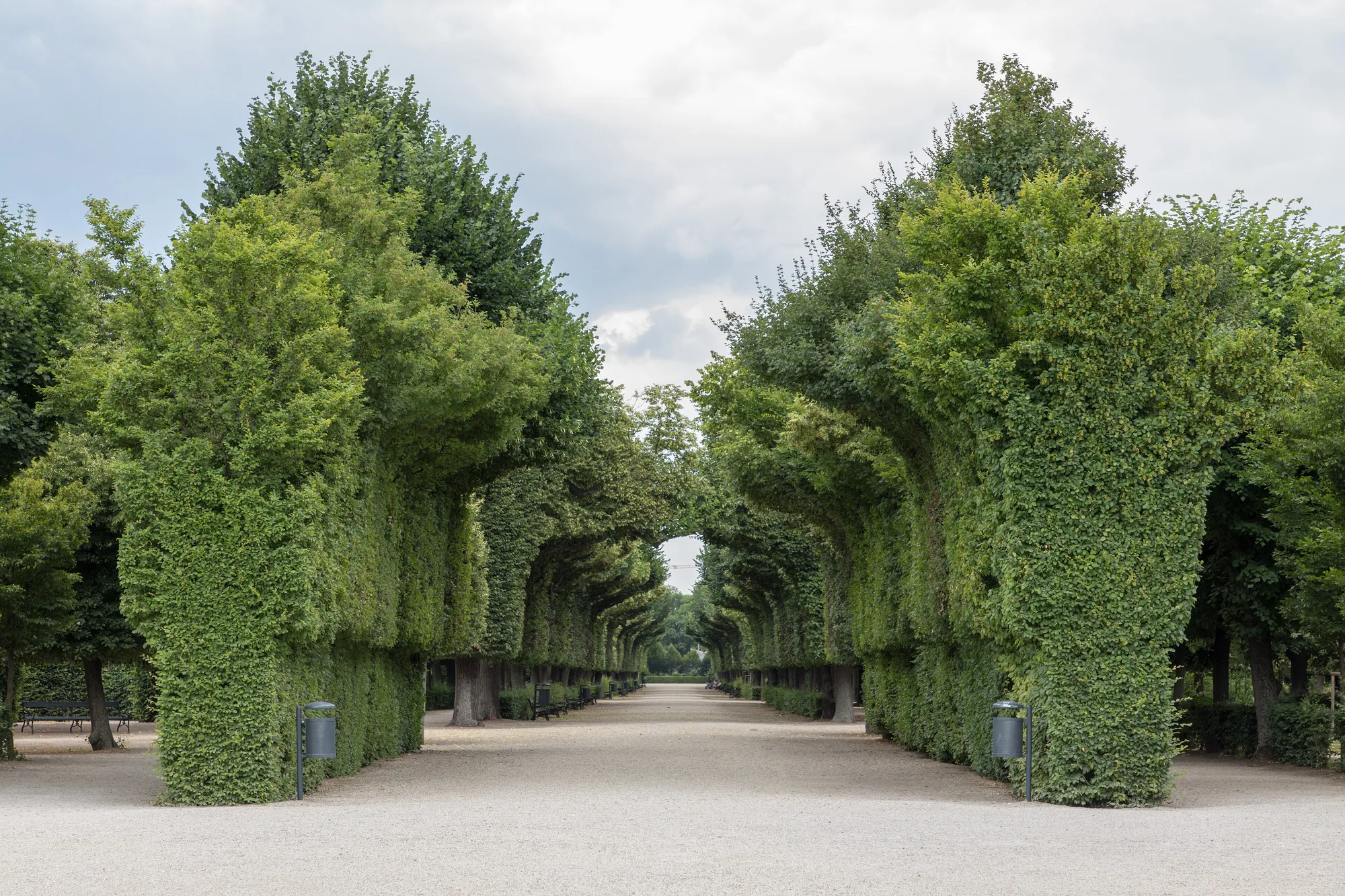
A residence framed by a garden
At Schönbrunn, the view out of the window was part of the story.
02 / Ambition and interruption
A project shaped by changing fortunes
The Ottoman siege of Vienna in 1683 damaged the earlier buildings at Schönbrunn. In 1693, Emperor Leopold I commissioned the architect Johann Bernhard Fischer von Erlach to design a grand new hunting lodge. Work began in 1696. The ambitious first vision proved too costly and impractical to complete in its original form; war, financial constraint and the sudden death of Joseph I interrupted construction.
The result was not one uninterrupted building campaign, nor simply a plan carried out as first imagined. A central section was occupied around the turn of the eighteenth century, while later rulers and architects revised both the palace and its purpose. Schönbrunn gradually moved from a hunting lodge toward an imperial summer residence.
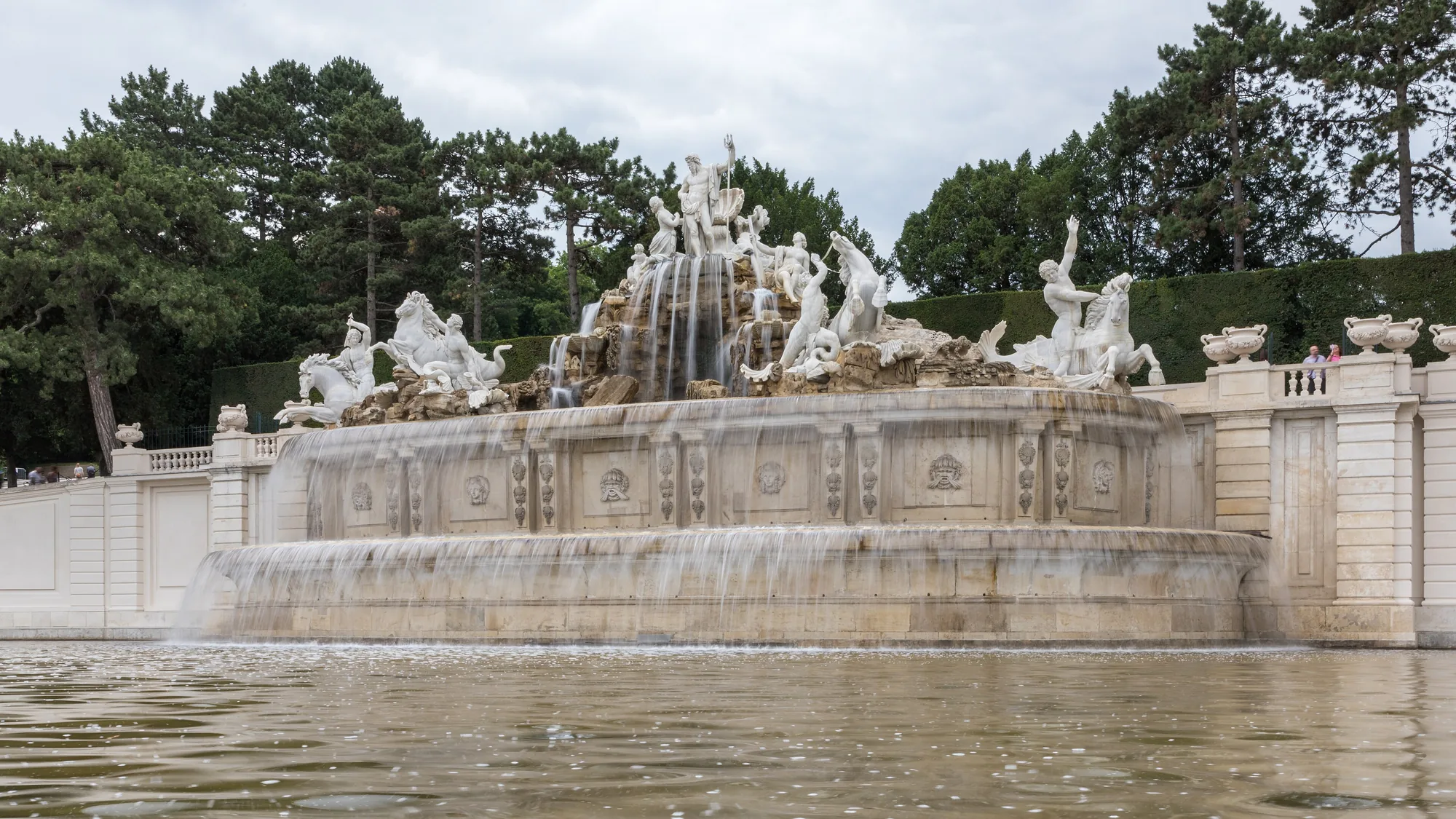
The gardens developed alongside it. Baroque formality arranged terraces, paths and water features so that nature itself appeared ordered and legible from the palace. That visual relationship—house at one end, long axis, hilltop monument at the other—helps explain why the grounds still feel inseparable from the architecture.
Maria Theresa makes it a summer court
The decisive transformation took place during the reign of Maria Theresa, from 1740 to 1780. Schönbrunn expanded into a major summer residence and the interiors acquired the eighteenth-century character that defines the palace visit now. Court architect Nicolaus Pacassi helped reshape the building; Rococo rooms, ceremonial spaces and private apartments express the court’s appetite for display while keeping the routines of family life close by.
For history and gardens alike, this period is central rather than exclusive: later changes continued. The palace park opened to the public in 1778, while the court continued to use Schönbrunn as a working residence. The complex embodied Habsburg power, but its formal landscape also offered a carefully composed public face.
See the palace operator’s account of eighteenth-century architectural change for the building campaign and its rooms.
03 / The nineteenth century and beyond
A court, a changing city, a public monument
After Maria Theresa’s death in 1780, the palace was not continuously occupied as a summer residence. Its revival in the nineteenth century brought another turn in taste. Ahead of the Congress of Vienna in 1814–15, the building was renovated, and between 1817 and 1819 court architect Johann Aman altered the façades, removing much of their elaborate Rococo decoration. The simplified exterior is the one many visitors see today.
Franz Joseph was born at Schönbrunn in 1830, made the palace a centre of his later life, and died there in 1916. UNESCO describes Schönbrunn as the residence of the Habsburg emperors from the eighteenth century to 1918. The end of imperial rule changed the palace’s function again: no longer a private court setting, it became a historic place to be interpreted and visited.
The Palace and Gardens of Schönbrunn were inscribed on the UNESCO World Heritage List in 1996. The designation recognizes the ensemble, not just the façade: architecture, interior arts, gardens and setting combine into a designed whole. On a visit, the perspective changes between a furnished room, a terrace, and the far end of the garden axis. That movement across the site is one way to notice how each era added to, or revised, the meaning of Schönbrunn.
For the World Heritage description, see UNESCO’s Palace and Gardens of Schönbrunn page . The operator’s palace history overview provides a more detailed architectural chronology.
Next, the practicalities