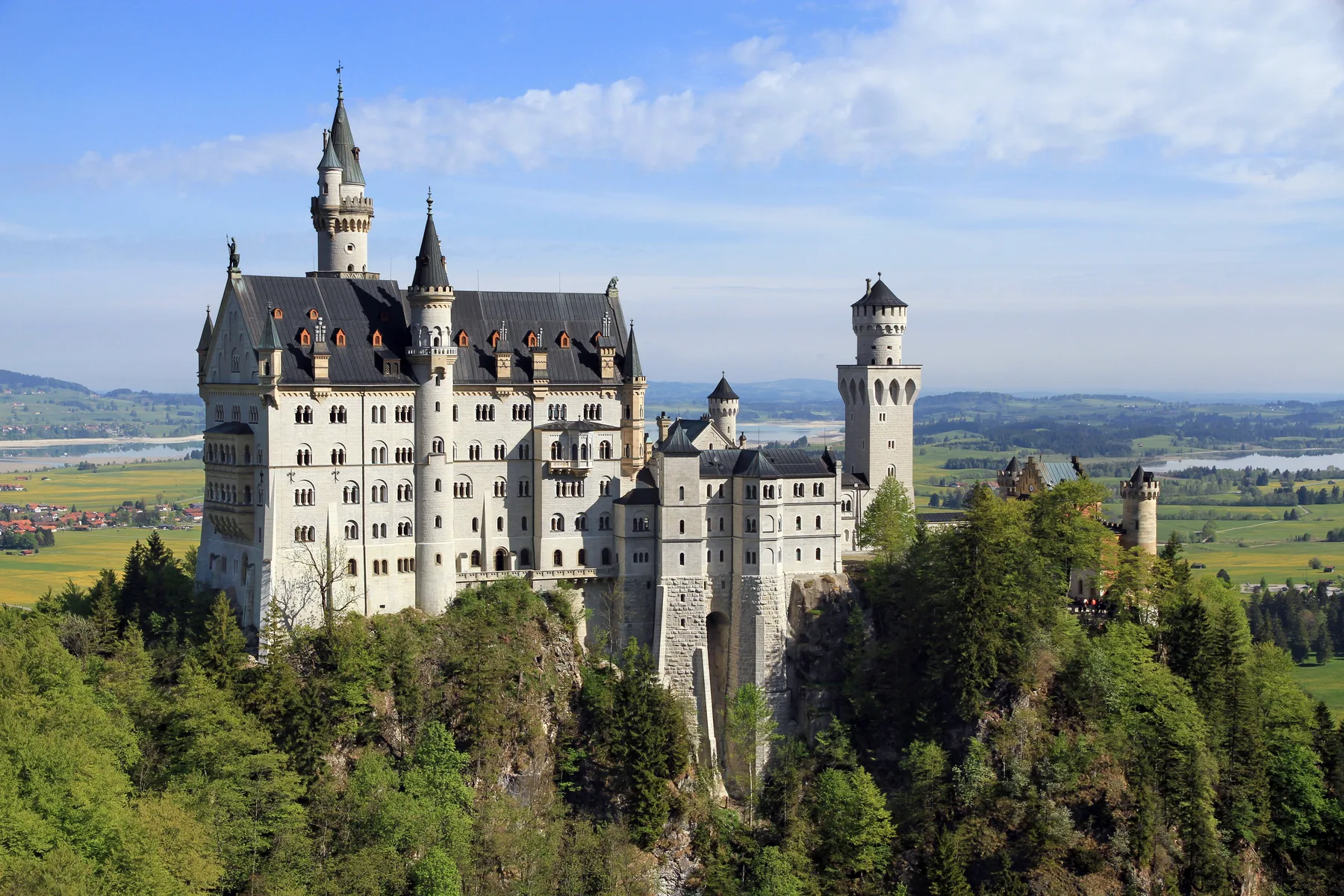
Neuschwanstein is often described as a fairy-tale castle. The phrase captures its silhouette, but can obscure the more intriguing fact: this was an ambitious nineteenth-century building project, conceived as a personal world by King Ludwig II of Bavaria.
The young king and his imagined past
Ludwig II became king in 1864. The Bavarian Palace Administration connects his fascination with the Middle Ages to his childhood at nearby Hohenschwangau, which his father Maximilian II had rebuilt in a Gothic style. Its murals, stories and historic atmosphere helped form the young prince's imagination.
Music deepened that attachment. The Palace Administration identifies Ludwig's encounter with Richard Wagner's music dramas from 1861 as a decisive influence, particularly works such as Lohengrin and Tannhäuser. Neuschwanstein would give these legendary and theatrical worlds an architectural setting—not as a surviving medieval fortress, but as a nineteenth-century interpretation of medieval culture.
Construction on the ridge
Work began in 1869 on a ridge above the Pöllat Gorge, on the remains of two smaller castles familiar to Ludwig from his youth. The official account says he imagined the new castle as a monument to medieval culture and kingship. The building's romantic historicism used medieval styles and imagery, while incorporating technology that was contemporary to its own time.
That combination is central to understanding what you see. Neuschwanstein is neither a medieval survival nor a simple replica. It reflects nineteenth-century historicism: the deliberate study and reworking of earlier styles, with the confidence that an idealized past could be made present again. The Bavarian Palace Administration calls it the best-known work of historicism and an embodiment of German idealism.
An unfinished interior, an unfinished idea
The castle was never completed. Ludwig's project developed amid a changing political reality: following Bavaria's defeat and its subordination to Prussia in 1866, the king's sovereign role was constrained. The Palace Administration describes the castles as an alternative world in which he could imagine a different kind of kingship. The building therefore tells two stories at once: elaborate artistic intention and the limits of the world in which that intention took shape.
On a visit, look past the familiar outline. The theatrical composition of towers against the mountains, the revivalist references and the use of modern building methods all belong to a specific moment in European culture. Asking why a nineteenth-century king wanted to remake medieval legend is more revealing than asking whether the palace is “authentic.”
What to notice on site
- The setting: the ridge, gorge and peaks are essential to the intended dramatic effect.
- The historical references: the designs evoke medieval forms without being medieval fabric.
- The scale of the ambition: the castle remained incomplete, so the finished rooms are part of a larger unrealized plan.
- The visit format: the interior is experienced on a guided tour at a fixed entry time, not as an unrestricted self-guided palace visit.
For the official current account, consult the Bavarian Palace Administration's Neuschwanstein history. For the visit itself, see our visitor information and approach guide or read how the fixed-time tour affects Neuschwanstein ticket planning.