Editorial Guide
Angkor Wat
History.
Angkor Wat stands as a microcosm of the universe, shaped by royal ambition and intense spiritual devotion over centuries.
The Vision of Suryavarman II
Constructed in the early 12th century under King Suryavarman II, Angkor Wat was conceived on an unprecedented scale. Its dedication to Vishnu distinguishes it from many earlier Khmer state temples associated with Shiva. It is often interpreted as a state temple with a royal commemorative role, shaped by the symbolism of Mount Meru, the home of the gods in Hindu mythology.
Its west-facing orientation is unusual among major Khmer temples and has inspired discussion about religious symbolism and royal commemoration. The precise intentions behind every design choice cannot be established from the building alone. What is clear is the scale of the undertaking: the temple formed part of a much larger Angkorian landscape of reservoirs, settlements, roads and other sacred sites, not an isolated ruin.
Architectural Mastery
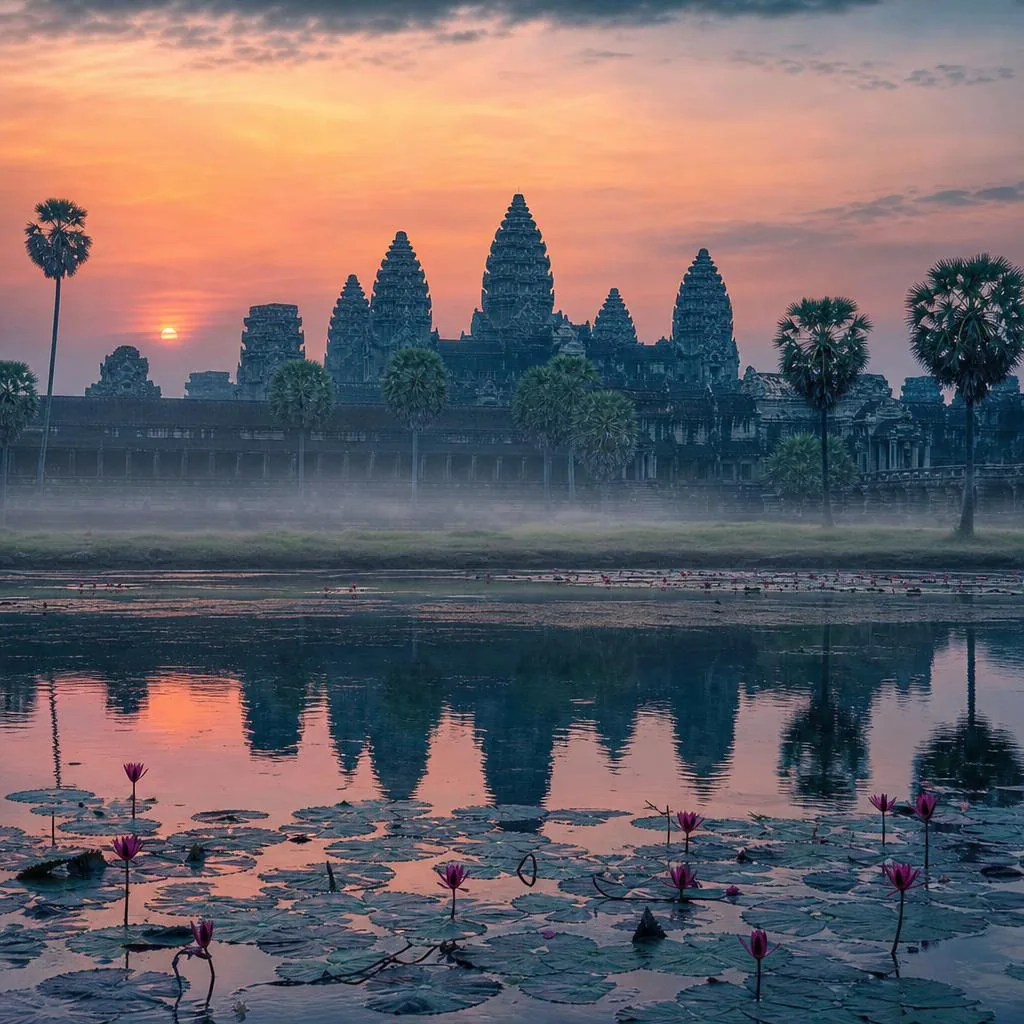
The temple's architecture represents the classical style of Khmer craftsmanship. It is surrounded by a vast moat that symbolises the cosmic oceans. Inside, a series of elevated, concentric galleries culminate in five central towers. The precision of the sandstone blocks, laid tightly without mortar, demonstrates a highly sophisticated understanding of weight, structure, and symmetry.
The walls themselves are canvases. Staggering lengths of bas-reliefs line the outer galleries, depicting grand Hindu epics such as the Ramayana and the Mahabharata, alongside scenes of Suryavarman II's military triumphs and visions of heaven and hell.
The galleries reward unhurried looking. Mythological scenes and courtly processions sit beside finely worked architectural details; their order and imagery reveal how religion and royal authority were expressed in stone. If you plan to spend time studying these carvings, compare the slower routes in our Small Circuit and Grand Circuit guide rather than trying to see every temple in one morning.
Angkor Wat in a Wider City
The temple is one part of an archaeological landscape extending across the former Khmer capital. Later rulers built and adapted other monuments, including those at Angkor Thom. Reading Angkor Wat alongside these neighbouring sites makes the empire's changing religious traditions and political centres easier to understand.
The park's size changes how that history can be experienced today. Allow time between monuments, and use our guide to deciding how many days to spend at Angkor Wat to build an itinerary around depth rather than a checklist.
The Shift to Buddhism
By the late 12th century, the Khmer Empire faced internal strife and external invasion. Under the reign of Jayavarman VII, the empire pivoted toward Mahayana Buddhism, culminating in the construction of the new capital, Angkor Thom, and the enigmatic Bayon temple nearby.
Consequently, Angkor Wat transitioned from Hindu worship to Theravada Buddhist use over the centuries. Monks cared for the site long after the political power of the empire had moved to Phnom Penh, ensuring it was never fully swallowed by the jungle like many surrounding temples.
The shift was gradual rather than a single moment of conversion. Images and devotional practices changed while earlier architectural and artistic layers remained visible. That continuity is one reason visitors should approach the complex as a living place of worship, not simply an archaeological exhibit.
A Living Monument
While European explorers in the 19th century popularised the romantic notion of a "lost city," Angkor Wat has always been known to the Khmer people. Today, it remains a powerful symbol of national identity, featuring on the Cambodian flag, and serves as a continuous site of pilgrimage and prayer for Buddhists from across the world.
Conservation now has to balance access, worship and the protection of vulnerable historic fabric. The APSARA National Authority is a primary source for stewardship and current conduct guidance. Before visiting, read our practical visitor information and follow on-site instructions around restricted areas and carvings.