The limestone beneath the streets
Quarrying left a network of galleries below the expanding city. The former workings provided the space that would later be used for the ossuary.
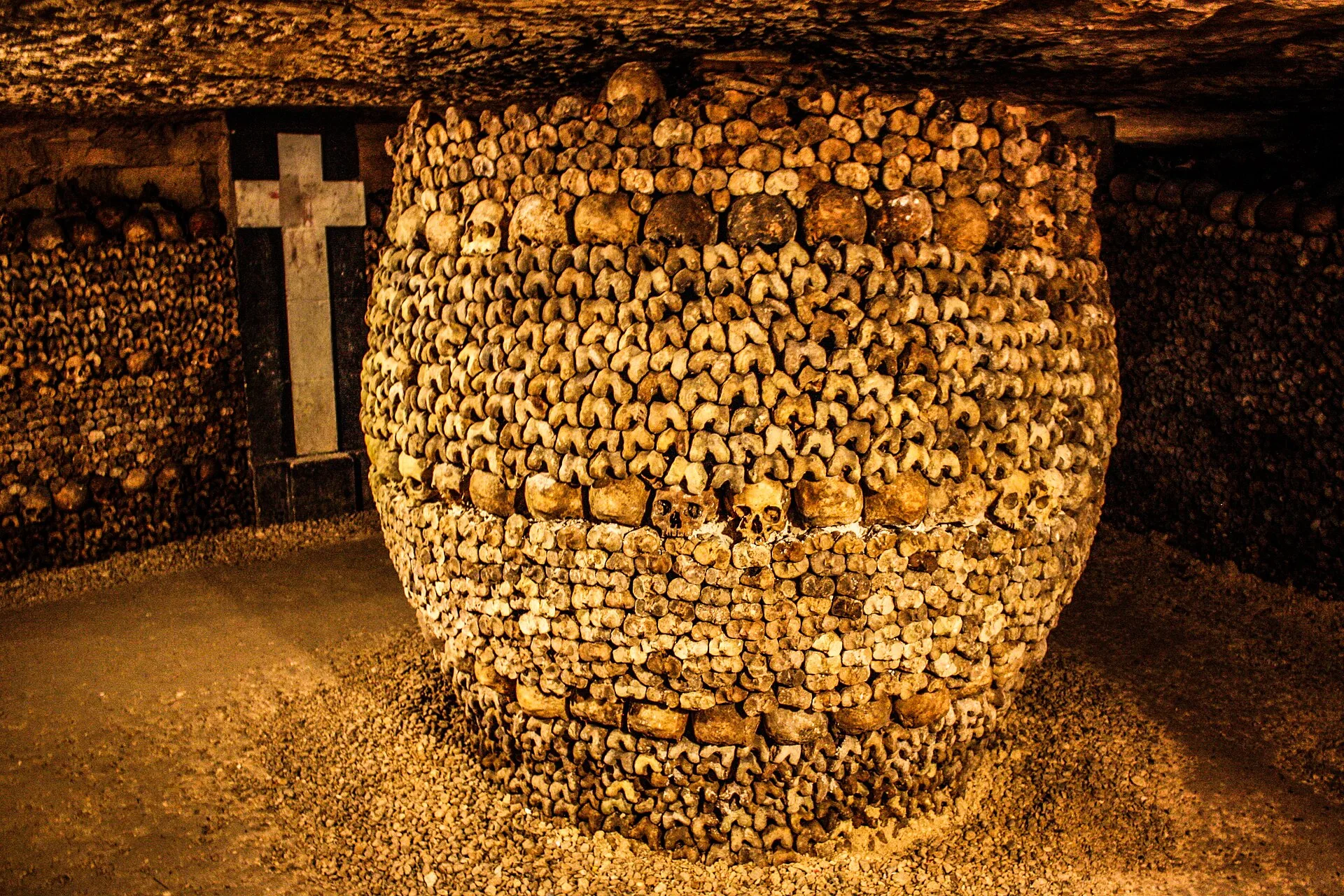
The story beneath Paris
How Paris’s quarries became a place to reckon with its dead.
Photograph of the Paris Catacombs ossuary; attribution in photography credits.
A history in layers
Before the Catacombs were an ossuary, the space beneath Paris was a landscape of working limestone quarries. Stone extracted from these galleries helped build the city above. As the city expanded over its old workings, the abandoned quarry network became a concern in its own right.
The ossuary is therefore two histories meeting: the story of stone and urban growth, and the story of how Paris confronted overcrowded burial grounds. The public visit reveals a portion of that much larger underground landscape, not the whole network.
A condensed chronology
Quarrying left a network of galleries below the expanding city. The former workings provided the space that would later be used for the ossuary.
Crowded urban burial grounds had become a public-health concern. Authorities sought a place to relocate remains, notably from the Saints-Innocents cemetery.
Human remains were moved into former quarry galleries. What had been a place of extraction took on a new civic and commemorative purpose.
The site gradually became a place of public encounter with the city's history. Its arranged walls of remains and inscriptions shape the experience known today.
Chronology based on the official site history .
The weight of the place
It is easy to describe the site only by its most striking visual element. That misses what the remains represent: people once buried in Paris, moved as the city made difficult decisions about land, health and death. The galleries are both a historical intervention and a resting place.
To visit well is to hold those ideas together. Read the inscriptions, pay attention to the transitions between the quarry spaces and the ossuary, and leave the route as you found it.
Plan a respectful visitHuman remains in the ossuary; please approach the site with respect.
Then & now
Today's public circuit is approximately 1.5 km, from the entrance near Denfert-Rochereau to the exit on Avenue René-Coty. The physical route is only a narrow window onto a longer history. Before you go, understand its 131 steps down, 112 steps up and lack of step-free access.
The official operator is the authority on visitor conditions. For the story, start with its site history; for the logistics, use its useful information.
Independent editorial guide. Noble Voyages is not affiliated with Paris Musées, the Catacombs operator, or the official ticket seller. Check live operator information before travelling or paying.
Official sources: official Catacombs site history; official route and practical information.