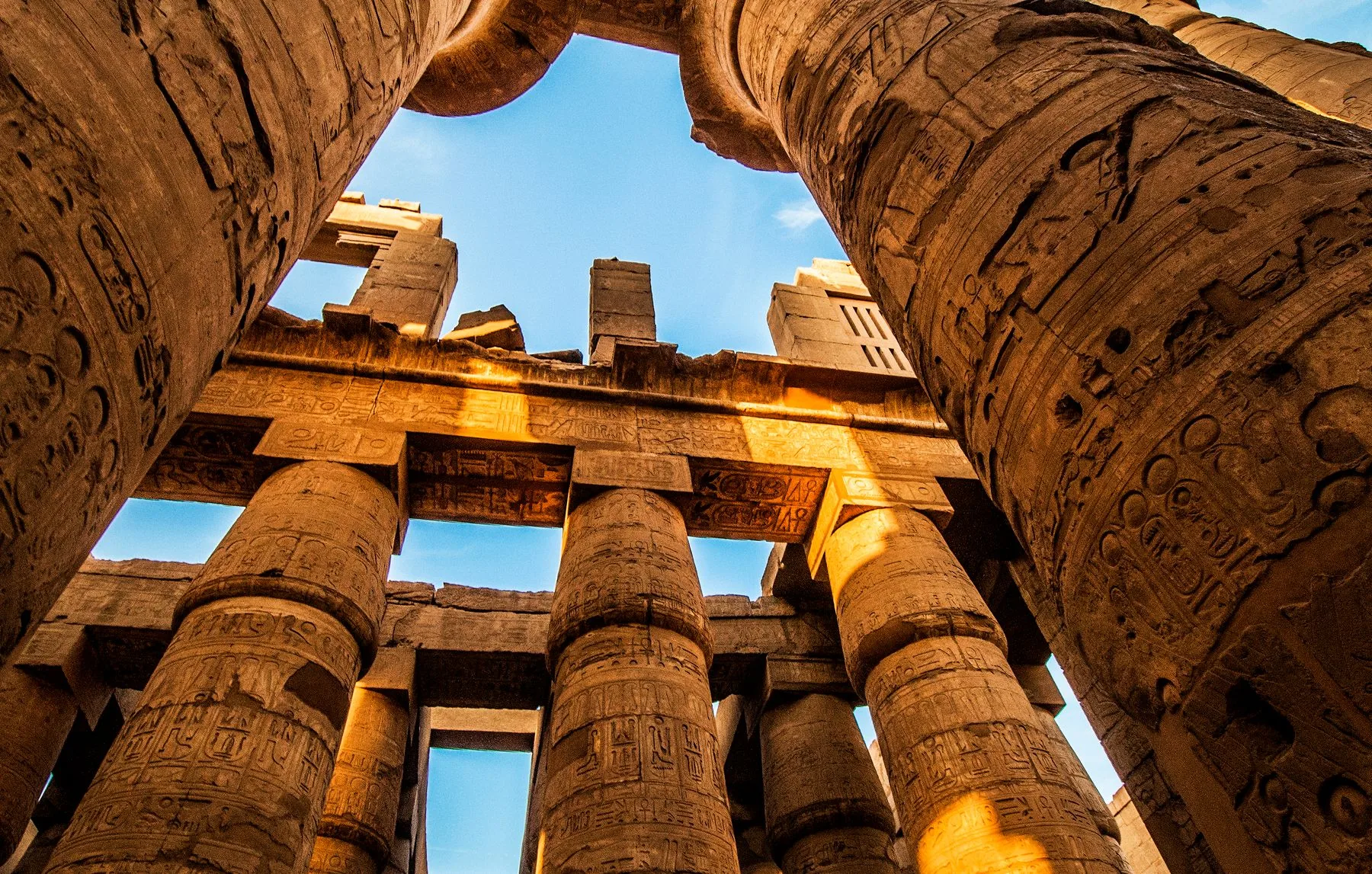
The long view · Luxor
Karnak
Through Time.
Not a monument made in a moment. A sacred landscape rewritten in stone across generations.
01 / A place that kept growing
Architecture as an accumulation
To call Karnak a temple is useful shorthand, but it can obscure what makes the place extraordinary. This is a complex of sacred spaces, not a single design executed at once. Rulers built, extended, decorated and sometimes altered what earlier generations had left behind. Its courts and gateways therefore read less like a straight line than like a conversation over centuries.
The great precinct honours Amun, a deity whose importance became closely entwined with royal power at Thebes. Processional routes, monumental pylons and enclosed holy spaces helped shape the experience of approaching the divine. Much of what survives is architecture made to be encountered in stages; even today, one threshold changes the view of the next.
Look for that sequence on the ground, not just on a diagram. A court gives way to a gateway; a sunlit stretch becomes a close passage; inscriptions sit beside other inscriptions from a different reign. Our Karnak overview offers a route for seeing the major spaces without flattening them into one period.
The hall of columns
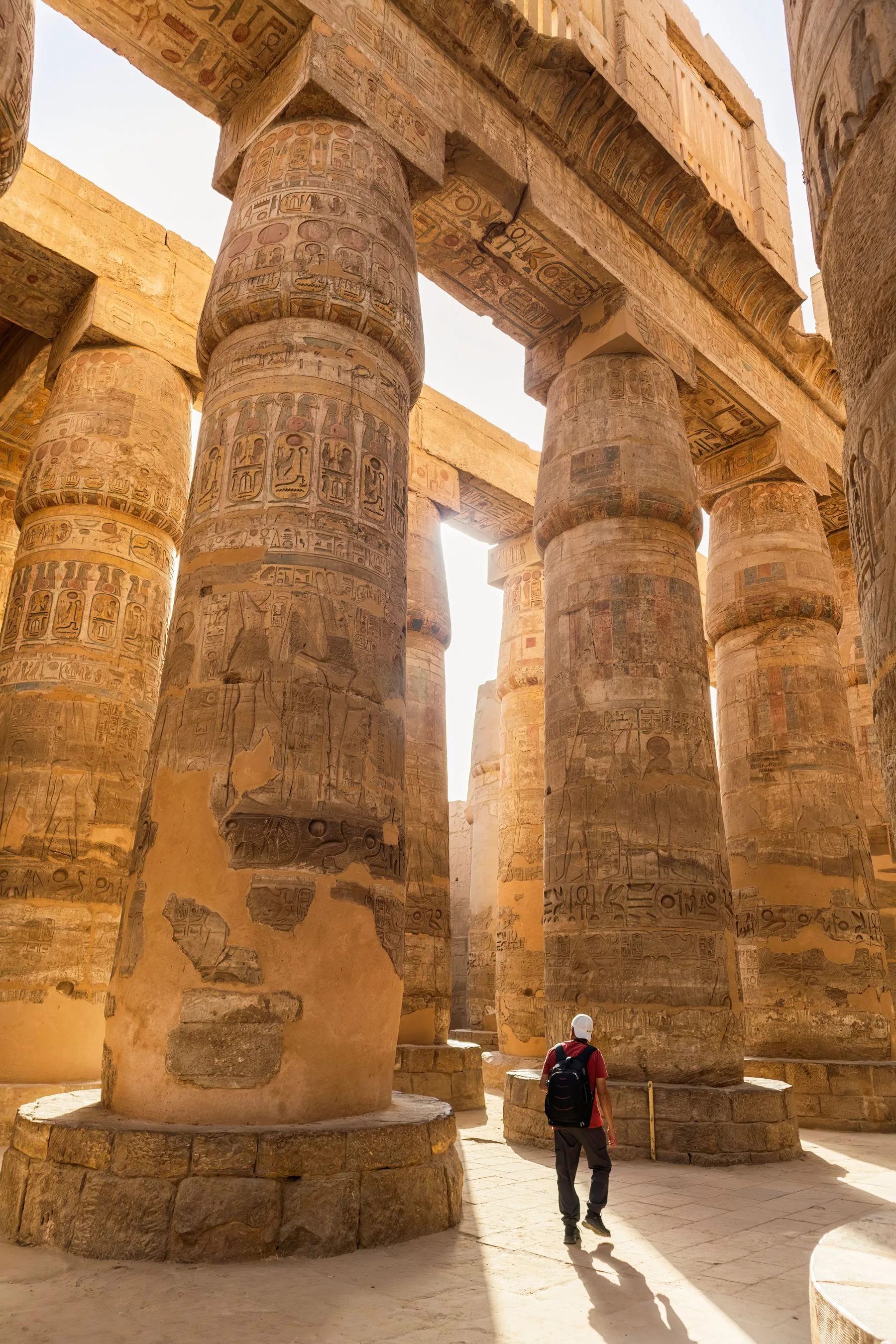
From a distance, a forest. Up close, each column is a surface for stories.
02 / The Amun precinct
Inside the Great Hypostyle Hall
At the heart of the familiar visitor route is the Great Hypostyle Hall, with 134 massive columns. The central aisle rises higher than the columns around it; the arrangement draws your eye upward while the closely spaced supports change how you move through the room. It is an architecture of repetition that never feels quite the same from one position to the next.
The carved surfaces carry religious and royal imagery, not merely decoration. Reliefs, inscriptions and surviving traces of colour speak to how the building communicated authority and devotion. It is easy to photograph only the scale; take a moment with individual surfaces, and with the sharp changes between sunlight and shadow.
Beyond a single famous room
The hall is not all of Karnak. The larger Amun precinct contains successive courts, gateways and sacred buildings. Elsewhere in the complex, the precincts associated with Mut and Montu remind us that the site's religious geography was broader than a single god or axis. Modern visitor categories do not necessarily cover every area: the official Egyptian monument listing treats the Mut Temple separately and gives the Open Museum its own category-specific terms.
The Egyptian government's Karnak page is a useful primary reference for the precinct and present-day site categories. Before planning an extended circuit, consult our practical visitor information and the admission guide.
03 / The wider landscape
Karnak and Ancient Thebes
It is tempting to imagine Karnak as an isolated archaeological park. In antiquity it belonged to a wider ceremonial and urban world beside the Nile. Luxor Temple to the south and the monuments across the river help restore some sense of that larger setting, even though today's streets and site boundaries make each stop feel separate.
UNESCO includes both Karnak and Luxor within the World Heritage property Ancient Thebes with its Necropolis . That designation is a reminder that this story extends beyond one set of columns, across temples and tombs and the ways they relate to each other.
For a day that gives both east-bank sites their own space, read our Karnak and Luxor Temple itinerary. A guided or independent visit changes how you encounter the layers, but neither replaces looking carefully at the stone.
Independent editorial guide · Updated 27 September 2026
Next, the practicalities