The long view · Athens
Acropolis
History.
The hill’s story starts long before the marble temples—and continues in the careful work needed to preserve them.
01 / A defended height
The citadel before the classical city
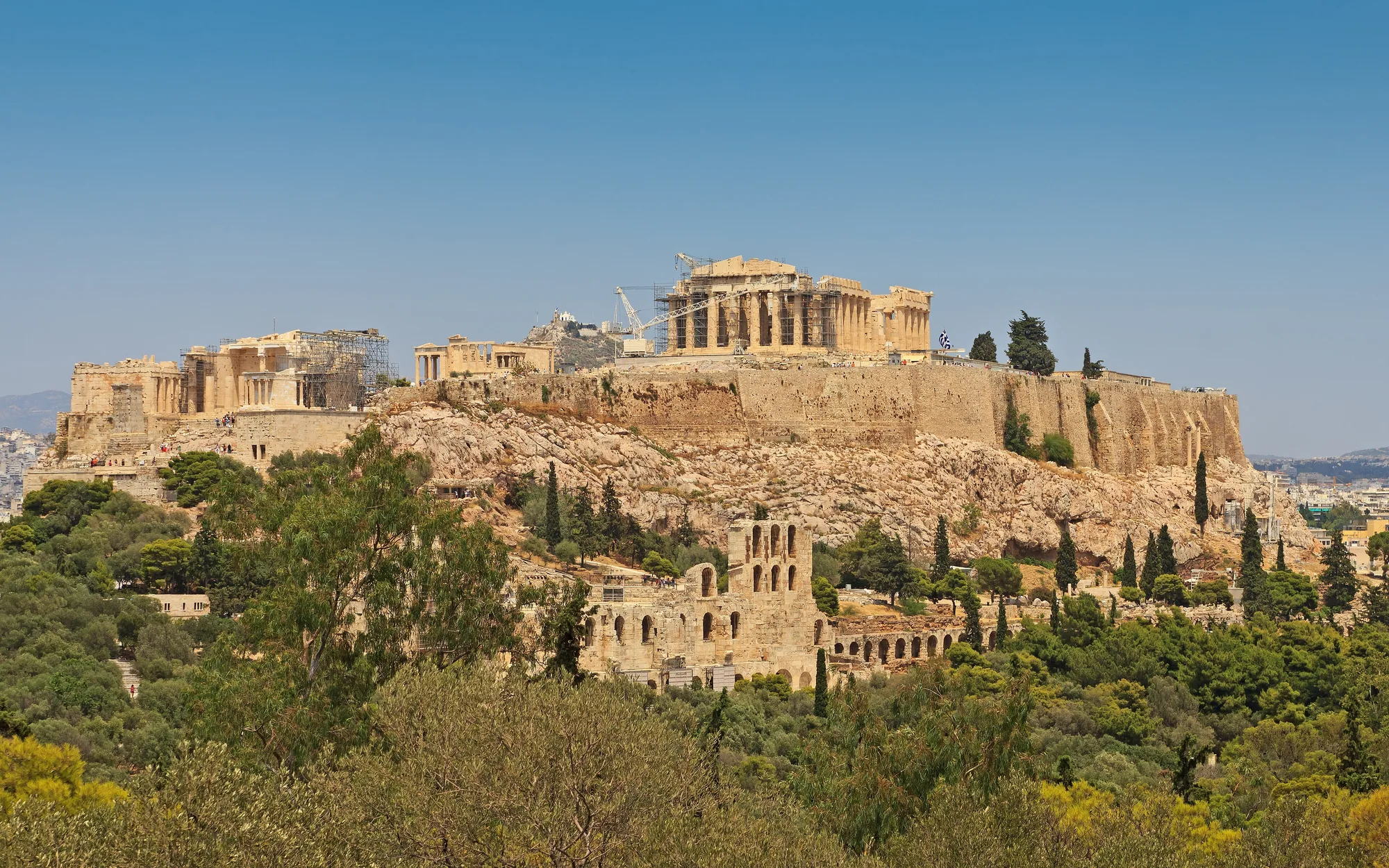
The Acropolis is first a place in the landscape: a steep limestone hill with command of the surrounding plain and a protected source of water on its slopes. Hellenic Heritage describes occupation from the third millennium BCE and the growth of a Mycenaean settlement. In that early role, the summit was powerfully defensive as well as habitable—a high refuge whose contours still determine how visitors approach it.
Its meaning changed. By the eighth century BCE the hill had taken on a sacred character, with the cult of Athena Polias central to its identity. The historical Acropolis is therefore not simply an architectural set created all at once in the age of Pericles. It was a place already charged with memory and religious significance when new monuments were planned.
For this earlier sequence and the site’s own account of its past, begin with the official Hellenic Heritage history of the Acropolis. It supplies the human chronology to keep in mind as the physical difficulty of the ascent makes the hill’s strategic shape apparent.
An interrupted beginning
The marble summit people know was made after a destruction—not instead of it.
02 / Destruction and rebuilding
The Persian sack and the fifth-century programme
In the early fifth century BCE, Athenians began a large predecessor temple after their victory at Marathon. The Persian invasion of 480 BCE broke that building programme: the invading army plundered the Acropolis and burned its monuments. The damaged hill was not an empty canvas. Its fragments carried the story of what had been lost into every later act of construction.
From the middle of the fifth century, the Acropolis took on the ensemble that defines its outline today. Athenian leader Pericles sponsored an ambitious programme; sculptor Pheidias provided artistic direction. The Parthenon, Propylaea, Erechtheion and Temple of Athena Nike are distinct buildings with different purposes, but their relationship on the hill produces a unified architectural composition. UNESCO’s official account frames the programme in the political, artistic and civic energy of fifth-century Athens.
Stand at the Propylaea and the route itself gives the idea form: a formal entry opens onto the summit, and each monument claims a different view or sacred role. The Erechtheion’s irregularity is a useful counterpoint to the Parthenon’s iconic geometry. For the official international heritage description, read UNESCO’s account of the Acropolis, Athens.
Architecture becomes a record of change
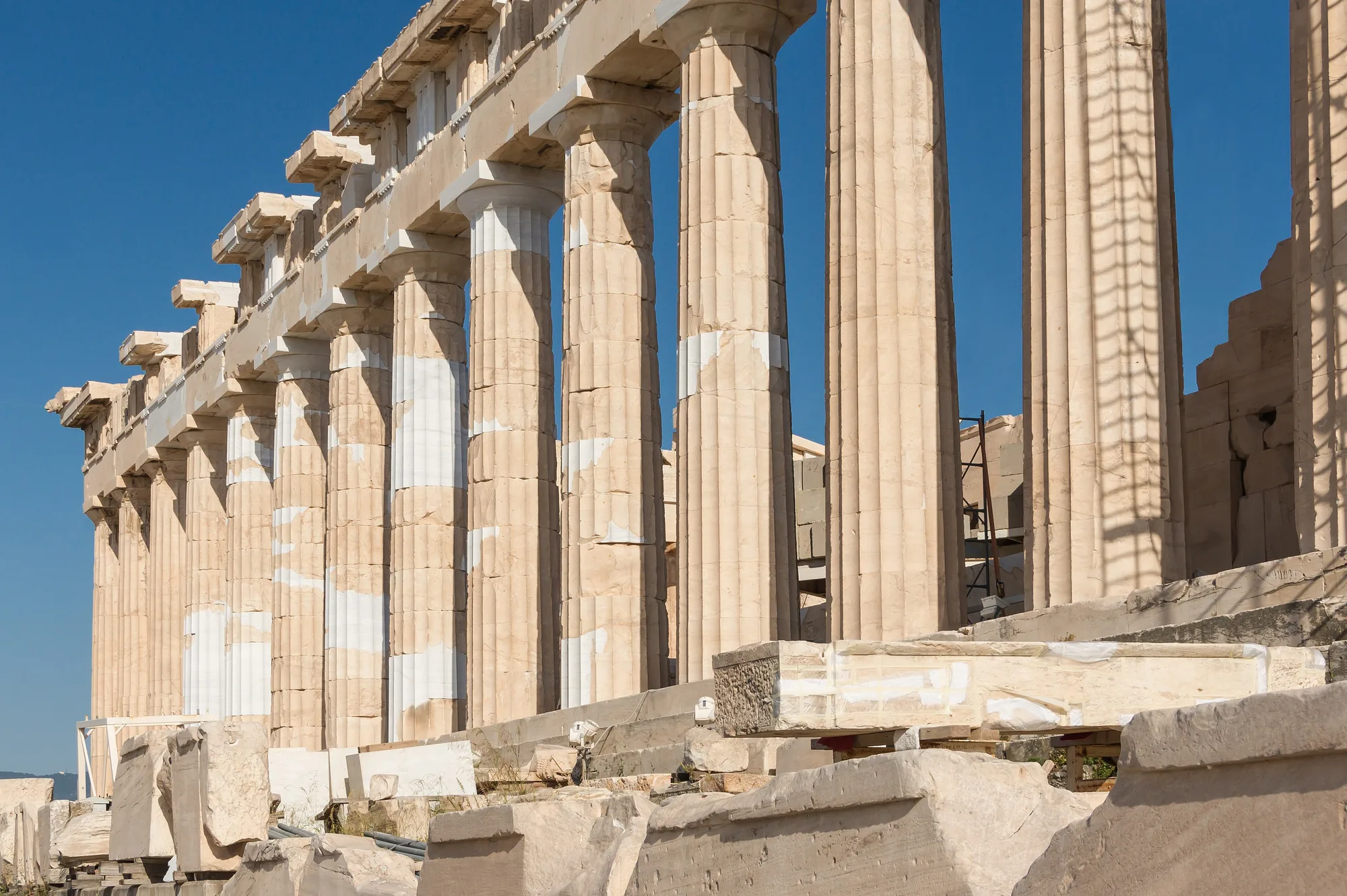
The Acropolis did not retain one use under every later government or religious community. Buildings were adapted, damaged and repaired across centuries; sculptures and architectural elements were removed or displaced, and the site was shaped by the circumstances of its later lives. Looking closely means reading more than a reconstruction of classical appearance: it means noticing the evidence, the absences and the distinctions between ancient fabric and modern supports.
03 / Conservation and interpretation
Restoration is an ongoing chapter.
Since 1975, the Acropolis Restoration Service (YSMA) has overseen conservation, restoration and enhancement work on the monuments, under the scientific responsibility of the Committee for the Conservation of the Acropolis Monuments. The official project account describes a research-led process: systematic documentation, focused study before intervention and careful reuse of surviving ancient material where appropriate.
This contemporary work is not a promise to make the hill appear untouched. It is an effort to stabilize what survives, correct past misplacements and make the buildings’ form more understandable while retaining their evidence. A scaffold or a modern stone supplement belongs to a different moment than the classical carving, but both are part of the site as it is experienced now.
See the monuments in context.
The ancient hill and its museum are close neighbours, not a single admission. Pair the archaeological site with a separate museum visit if the surviving sculpture and original context are central to your day.