Pompeii &
Herculaneum
These neighbouring archaeological destinations share an association with the eruption of AD 79, but they are not interchangeable stops. Expansive Pompeii and compact Herculaneum are separate parks with separate admission. Build a flexible plan around their different scale, access and transfer needs.
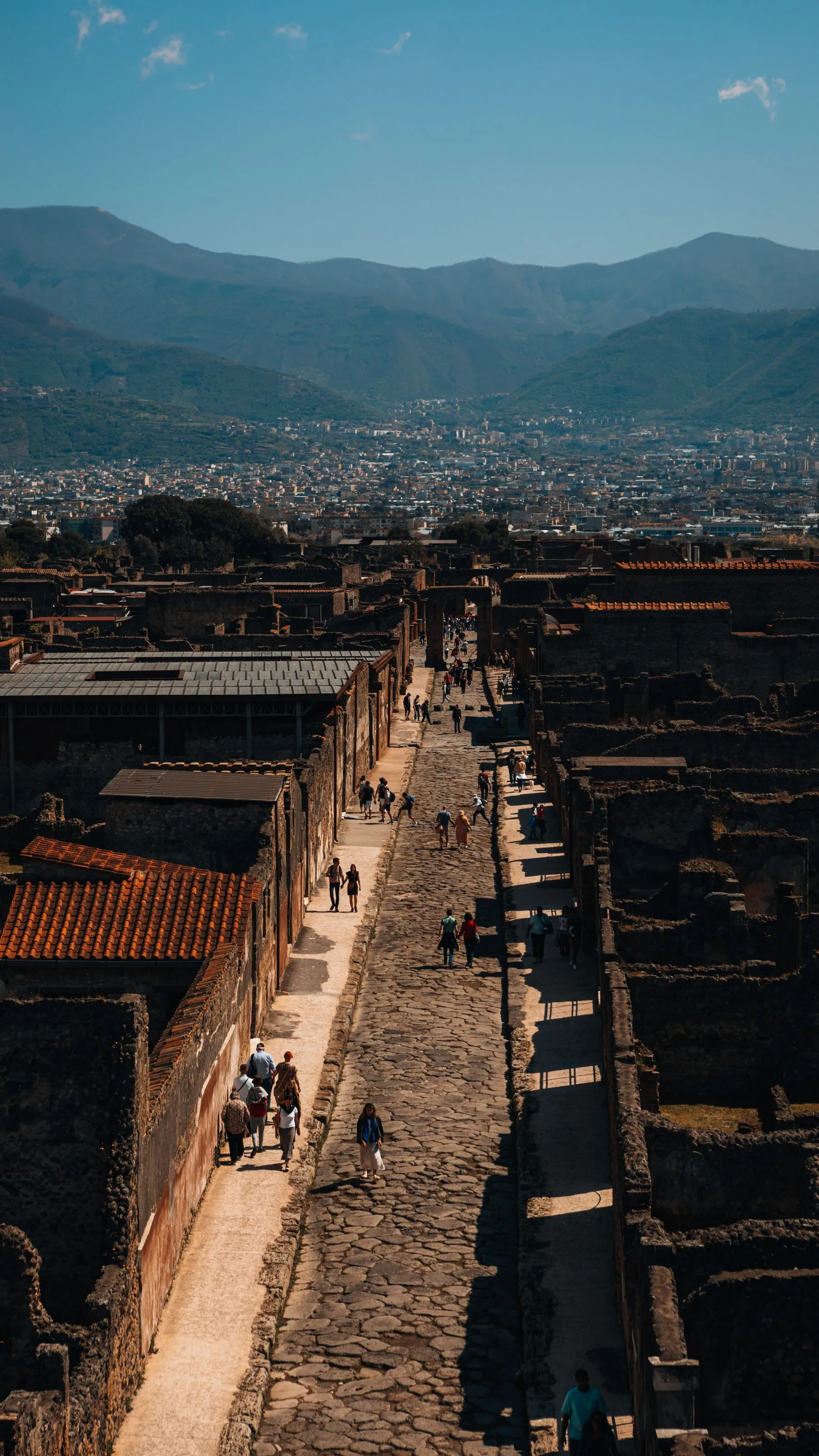
Pompeii and Herculaneum are often paired in conversation, yet visiting both is not simply a matter of repeating one experience twice. Pompeii unfolds across an expansive ancient city, with long walks between varied districts. Herculaneum is more compact, revealing another kind of urban setting in a smaller excavated area. Their shared history gives a useful point of connection; their distinct character deserves separate attention.
This article offers a flexible framework, not a fixed-day timetable. Each is an independently managed archaeological park, with its own current access information and ticket arrangements. Begin with the Pompeii overview, read about Pompeii’s history, and check Pompeii visitor information alongside Herculaneum’s own official park guidance.
Two sites, different scale and rhythm
Pompeii’s breadth is part of its significance and part of its practical challenge. Streets, public spaces and domestic remains spread across a substantial area, so a short visit necessarily involves choices. Even when you have a map, walking distances and changing access can affect how much you see. Select a few areas or themes—such as urban layout, homes, public life or conservation—instead of promising yourself a complete circuit.
Herculaneum’s excavated area is more compact, which can make it easier to form an overall impression in a shorter span. Compact does not mean superficial or interchangeable with Pompeii: preserved buildings and their arrangement offer their own encounter with an ancient town. Give it time for close observation rather than treating the visit as an afterthought once you have completed Pompeii.
UNESCO recognizes the archaeological areas of Pompei, Herculaneum and Torre Annunziata together as a World Heritage property, while each place retains its own distinct character. The UNESCO listing provides context on the significance of the ensemble. The common heritage is a reason to compare the sites, not a reason to flatten their differences.
Treat admission as two separate decisions
Pompeii and Herculaneum are separate parks, and their entry arrangements should be checked independently. Pompeii’s official timetable and ticket page explains the park’s ticket types and online sales through Vivaticket. Herculaneum’s own official ticket information is the source for its admission terms. Do not assume that a Pompeii multi-site ticket or pass includes Herculaneum; verify the precise scope of each admission with the relevant park before purchase.
The Pompeii authority states that visitors cannot re-enter after leaving. That restriction can affect whether you take a break inside or outside and how you arrange the rest of the day. Herculaneum’s conditions may differ, so consult its official guidance rather than transferring one park’s rule to the other. Ticket types, terms and access can change; this article intentionally gives no prices or fixed hours.
For a focused explanation of Pompeii admission information, continue to our official Pompeii tickets page. It is a separate planning resource, not a claim that an admission for one park provides entry to the other. Review the written terms of any transport, guide or combined service with the same care.
A flexible two-site checklist
- Check each park’s official opening, access and admission information for your date.
- Choose the site order around confirmed arrangements, transport and your interests.
- Allow uncommitted time for transfers, walking, entry procedures and breaks.
- Keep each visit meaningful; if the day becomes compressed, consider splitting it.
Order matters less than realistic pacing
There is no universal order for the two parks. You might give Pompeii the largest share of your energy because of its scale, or start with Herculaneum if that better fits the logistics of your stay. Make that choice only after checking each park’s current arrangements and the transport options relevant to your date. Avoid treating either site as a guaranteed first or second slot in a rigid schedule.
Trying to visit both in one day can mean a long day of walking, transitions and attention. The time needed at Pompeii varies widely with route, pace, weather and interests; at Herculaneum, a smaller footprint still deserves time to look carefully. Add the uncertainty of transport between towns and possible waits at the gates. A flexible itinerary leaves room for changes rather than inventing a transfer duration or a prescribed number of hours at each site.
If the practical window is too narrow, consider giving one park a dedicated day and the other a separate visit. You will get more from an unhurried encounter with one site than from arriving at the second exhausted or near the end of its current access window. Verify that window directly before making plans.
Plan entrances, transfers and physical effort
Pompeii has three entrances, according to the park’s official guide to visiting the excavations. Entry point choice can shape your starting area, so check current directions and consider the transport connection you will actually use. Do not assume every entrance offers the same route or that a particular gate will be appropriate without checking the day’s guidance.
The excavations include extensive walking over historic surfaces and in open-air conditions. If accessibility is part of your planning, the park’s Pompeii for All accessible route information outlines its dedicated route; confirm current details and how they relate to your needs. Also consult Herculaneum’s official park information directly for its site conditions. Do not infer that one park’s accessibility provisions apply to the other.
Transfers are a separate part of the itinerary, not a guaranteed connection. Check route options and service updates close to travel, and leave slack for delays, connections and the walk from transport to the entrance. If you book a driver or other service, agree the pickup locations, waiting arrangements and terms in advance. No transfer provider controls the parks’ queue or access procedures.
Read for context, then compare what you see
The eruption of AD 79 buried both towns, but the resulting archaeological stories should not be reduced to one identical narrative. UNESCO’s heritage description offers a useful framework, and a little preparation helps you notice how the plan, scale and preserved spaces differ. At Pompeii, look at the structure of a city; at Herculaneum, give close attention to the distinct material and spatial qualities of its remains.
For a more interpretive approach at Pompeii, see our guide-versus-independent comparison. For seasonal walking conditions and changing daylight, read the best-time-to-visit article. These journal guides complement our Pompeii overview, history resource, visitor information and official Pompeii tickets information.
Make the plan serve the sites, not the other way around. Two distinct parks, with separate official entry and flexible timing, offer a richer comparison than a tightly timed checklist ever can.
Verify both parks before travel
Check each site’s current admission and access details, then leave room for the journey between them.
Visitor InformationSources & Verification
The parks are distinct destinations with separate admission and changing access details. Confirm each park’s current requirements; no fixed schedule, transfer duration or shared ticket is promised.
- Pompeii park official timetables, ticket types and Vivaticket
- Pompeii official entrances and visit guidance
- Pompeii for All accessible route
- Herculaneum archaeological park official tickets
- UNESCO World Heritage listing
Last Reviewed: 27 September 2026