Florence Art Galleries: What to See and How to Book
A practical guide to Florence art galleries: Renaissance masterpieces, modern and contemporary spaces, hours, ticket rules and how to plan a day around them.
Published
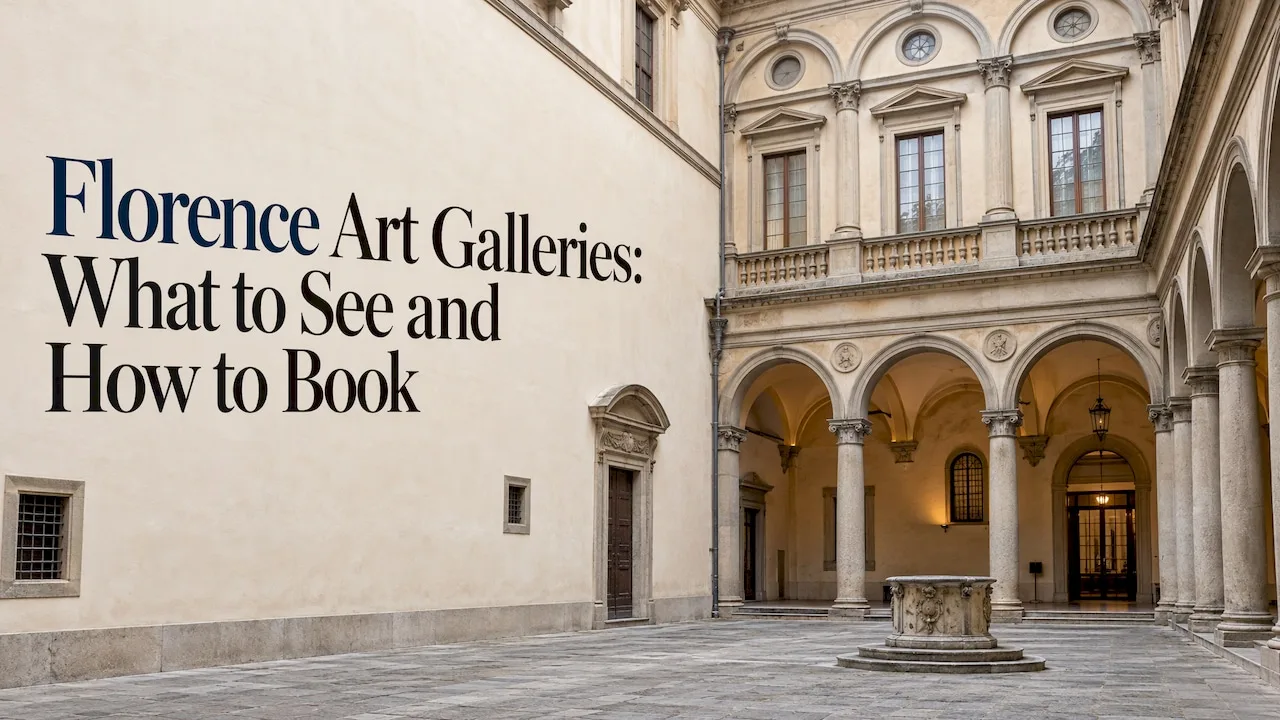
Florence has two galleries you will want to book before anything else: the Uffizi for Renaissance painting and the Galleria dell’Accademia for Michelangelo’s David. Around them sits a second tier that many visitors miss: the Gallery of Modern Art in Palazzo Pitti, Museo Novecento for twentieth-century Italian art, and Palazzo Strozzi and the Murate Art District for contemporary work. This guide explains what each one is known for, who it suits, and how to handle hours, tickets and timing.
Key Takeaways
- Book the Uffizi and the Accademia ahead of time. Both are among the most visited places in Italy, and the Accademia officially recommends reservations.
- Match the gallery to your taste: Renaissance at the Uffizi, Neoclassical and Macchiaioli painting at the Gallery of Modern Art, Italian twentieth-century art at Museo Novecento, rotating international shows at Palazzo Strozzi.
- Check closing days before you fix a day plan. The Accademia closes on Mondays and Museo Novecento on Thursdays.
- Contemporary art in Florence is real and varied, from Forte Belvedere’s terrace shows to the residencies at MAD.
- Exhibition dates and prices change every season, so confirm them on the gallery’s own page before you buy.
The Florence galleries at a glance
| Gallery | Best for | Practical notes |
|---|---|---|
| Uffizi | Renaissance and medieval painting | Official ticket site and phone line; book ahead |
| Galleria dell’Accademia | Michelangelo’s David | Closed Mondays; reservations strongly advised |
| Gallery of Modern Art, Palazzo Pitti | Neoclassical, Romantic and Macchiaioli painting | Second floor of Pitti Palace |
| Museo Novecento | Italian art of the 20th and 21st centuries | Closed Thursdays; open 11:00 to 20:00 otherwise |
| Palazzo Strozzi | Large international exhibitions | Tickets online recommended; programme changes often |
| MAD, Murate Art District | Contemporary art, residencies, performance | Exhibition hall plus performance space |
| Forte Belvedere | Contemporary shows with city views | Exhibitions vary by season |
Renaissance masterpieces: the Uffizi and the Accademia
The Uffizi Gallery
The building was designed by Giorgio Vasari and constructed between 1560 and 1580. According to the Uffizi Galleries, the gallery occupies the first and second floors and is known for ancient sculpture and for paintings from the Middle Ages to the modern period. For Renaissance painting, this is the room-by-room story: the same source lists works by Giotto, Botticelli, Leonardo, Raphael and Michelangelo among its highlights.
The Uffizi is also the answer to the question of Italy’s most famous gallery. In a 2023 ranking, it placed third among Italian sites with 5,138,588 visitors, behind only the very largest monuments. Crowds are the reason booking matters.
Tickets are sold on the official Uffizi ticket page, which lists the dedicated ticketing website and a phone line: 800 615 615 toll-free in Italy and +39 055 0354135 from abroad, from 8:00 a.m. The visitor information page also places the ticket offices under the Uffizi loggia, in front of Palazzo Pitti and at the Boboli Garden gates. Buying through the official channels keeps your price clean and your entry time under your control.
Plan on a long, focused visit. A common mistake is trying to see every room. Choose the century that interests you, start there, and treat the rest as a bonus.
Galleria dell’Accademia and the David
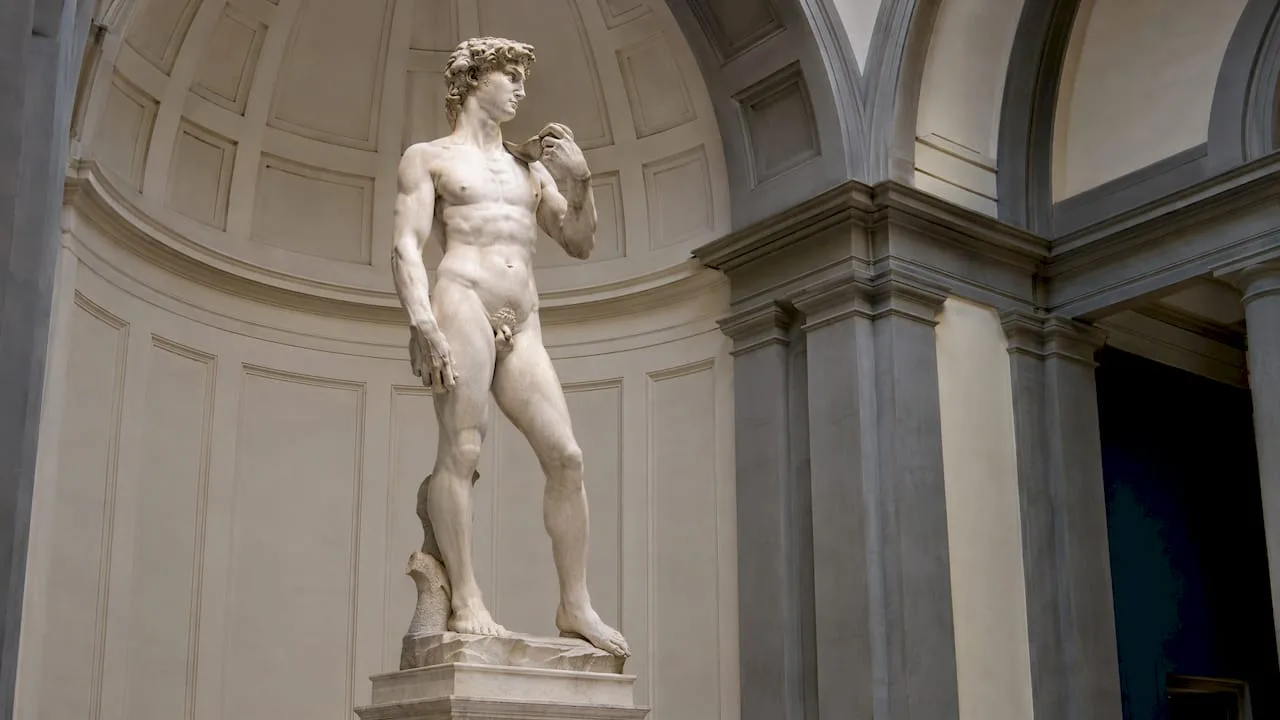
If you are asking which gallery holds the David, it is the Galleria dell’Accademia. According to the official visitor kit, the statue stands in the Tribuna at the end of the Prigioni corridor. It was carved between 1501 and 1504, and it was moved from Piazza della Signoria on the night of 31 July 1873. The Tribuna was completed in 1882. The same kit puts an average visit at about 1 hour 30 minutes, which makes the Accademia an easy pairing with a second gallery on the same day.
The official visit page gives the working details:
- Open 8:15 am to 6:50 pm, with last admission at 6:10 pm.
- Closed Mondays, 1 January and 25 December.
- Regular admission is 20 €. EU citizens aged 18 to 25 pay 2 €.
- Reservations are highly recommended, and access to some rooms stops from 6:40 pm.
- The first Sunday of each month is a free-admission day. On free days the booking service is not active and visitors wait at the entrance gate.
Accessibility is clearly handled. The exhibition halls and galleries are wheelchair accessible, with an accessible entrance and ticket office at Via Ricasoli 60 and a restroom near the ground-floor lift.
A practical point on the David: the original has been indoors since the nineteenth century. The statue you see in Piazza della Signoria is a copy, so the Accademia is the only place to see the marble itself.
Modern art: Pitti Palace and Museo Novecento
Gallery of Modern Art, Palazzo Pitti
This is the gallery that tops many search results for this topic, and it deserves the attention. According to the Uffizi Galleries page, it occupies rooms once inhabited by the Habsburg-Lorraine family on the second floor of Pitti Palace. Its paintings and sculptures run from the end of the eighteenth century to the first decades of the twentieth, and include Neoclassical, Romantic and Macchiaioli works by artists such as Hayez, Lega, Signorini, Fattori, Pissarro, Rosso, Boldini and Nomellini.
This suits visitors who have had enough Madonnas for one trip. The Macchiaioli, Tuscan painters who worked in patches of light and shade, show a side of Italian art that most first-time visitors never see. The setting adds to it: you walk through royal apartments rather than white-cube rooms. Because it sits within Palazzo Pitti, it combines naturally with the Boboli Garden on the same ticket plan, so ask the official ticket page which combination fits your day.
Museo Novecento
Museo Novecento, run by MUS.E, is dedicated to Italian art of the 20th and 21st centuries. It has a permanent collection and many temporary exhibitions, installations and special projects. Visit Tuscany describes it as an immersive space, focused on Italian art of the first half of the twentieth century.
The practical details from the museum’s own page:
- Open daily from 11:00 to 20:00, except Thursday, when it is closed.
- Full price is €13.00, reduced (18 to 25) is €9.00, and guided tours and activities are €8.00.
- The ticket office closes one hour before the museum does.
It is the quietest of the major collections, and a good choice for the late afternoon when the Renaissance galleries are shutting.
Contemporary art in Florence
Florence is not only a Renaissance city. If you want current work, these are the places to look.
Palazzo Strozzi
This Renaissance palace hosts large international exhibitions. Its Mark Rothko show drew 301,730 visitors in 162 days, reported as the most visited in the foundation’s twenty-year history. The project also extended to satellite venues, including the Museo di San Marco and the Biblioteca Medicea Laurenziana.
The lesson for planning is that Palazzo Strozzi exhibitions can be busy. The official tickets page strongly recommends buying online to ensure direct access and minimize waiting. It also states that advance tickets unused for reasons not attributable to the organizer cannot be refunded, and that groups of five or more must book in advance through the booking office. For the current show, hours, prices, audioguides and guided tours, use that page, since all of them change with each exhibition.
MAD, Murate Art District
MAD is a contemporary-art centre in a former prison complex. According to its own site, it has a hall for international exhibitions, a performance and theatre hall, and residences for artists and curators. It is the best fit for readers who want to see what is being made now, not what was made five hundred years ago.
Forte Belvedere
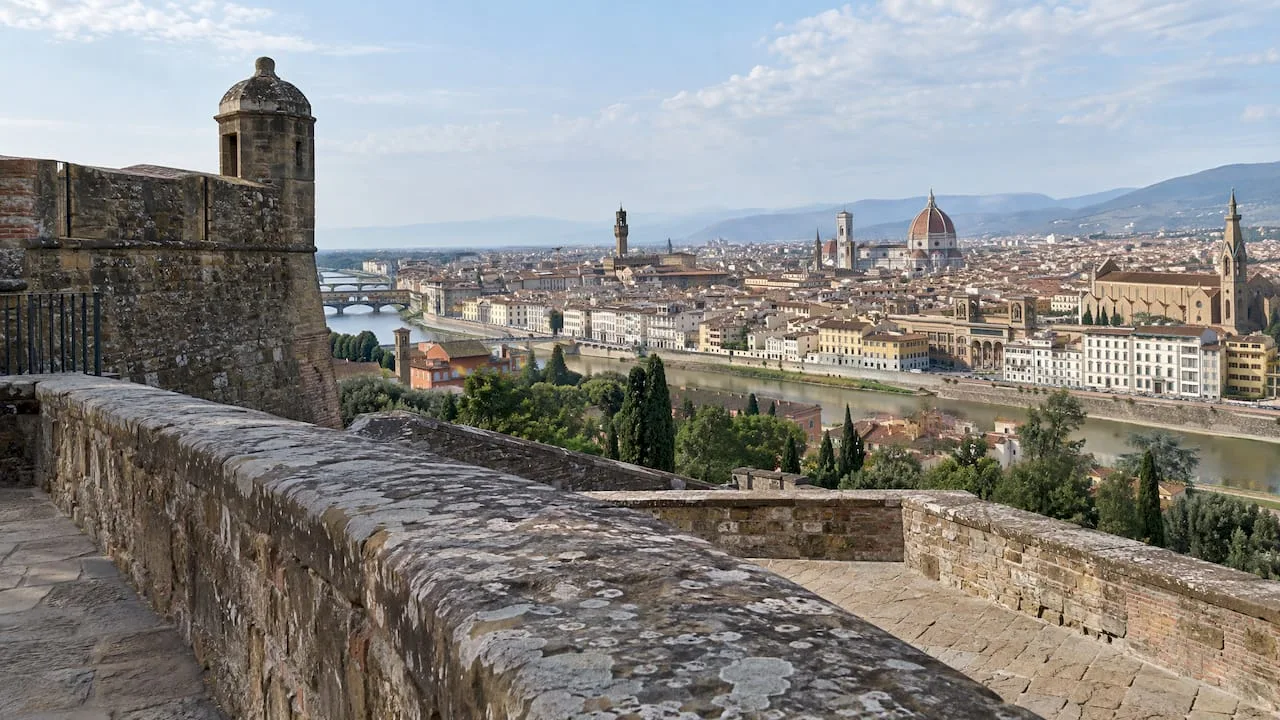
Visit Tuscany notes that Forte Belvedere often hosts exhibitions of contemporary artists and photographers, and that its terrace overlooks the city. It lists past shows by Zhang Huan, Giuseppe Penone, Antony Gormley and Jan Fabre. The mix of sculpture, fortress walls and a panorama makes it a rewarding half-day even when you are not chasing a specific artist.
Manifattura Tabacchi
The former tobacco factory is now a creative quarter. The official site describes shopping, food and drink, wellness, and an Art & Events programme, including a new event space called Motel. It works as a relaxed stop for coffee or an aperitivo after the more formal galleries.
What about Banksy in Florence?
There is no permanent Banksy in a Florence gallery, but there have been shows. An earlier exhibition, curated by Gianluca Marziani and Stefano S. Antonelli, ran at Palazzo Medici Riccardi from 19 October 2018 to 24 February 2019 and featured 20 of Banksy’s paper images, according to the Città Metropolitana di Firenze. In 2022 and 2023, an unauthorized multimedia show called Inside Banksy projected images and augmented-reality installations inside the church of Santo Stefano al Ponte. Both have closed, so look for a current exhibition listing rather than expecting a standing display.
Choosing by interest
- You want the great names of the Renaissance: the Uffizi, then the Accademia for the David.
- You prefer nineteenth-century painting in a palace setting: the Gallery of Modern Art at Pitti.
- You want Italian twentieth-century art without crowds: Museo Novecento.
- You want what is current: Palazzo Strozzi, MAD and Forte Belvedere, checking each programme first.
- You have one day only: Accademia in the morning, a long lunch, Museo Novecento or Pitti in the afternoon. Keep the Uffizi for a day of its own.
Booking and timing, in practice
Few things shape a gallery day more than closing days and booking windows. Here is a sequence that works.
- Fix the two anchor visits first. Reserve the Uffizi and the Accademia, since they are the ones that sell through.
- Build around closing days. The Accademia closes Mondays and Museo Novecento closes Thursdays. A Monday is better spent at the Uffizi or Pitti, and a Thursday at the Accademia.
- Use the official channels. Each museum quoted above has its own ticketing page, and they state the current prices and conditions.
- Allow time. About an hour and a half for the Accademia, far longer for the Uffizi, and a relaxed pace for the rest.
- Check exhibition calendars close to your trip. Programmes at Palazzo Strozzi and MUS.E change by season, and a show you want may open or close just before you arrive.
The same logic of choosing the right ticket and booking early applies across Europe’s major sites, as in our guides to Colosseum ticket types and Louvre ticket options.
Our perspective
Florence rewards restraint. The mistake we see most often is a plan that tries to touch every famous name in two days, and leaves the traveler remembering queues rather than paintings.
We design visits around fewer rooms, seen well. That means choosing the one or two galleries that match your interests, setting the entry times so the crowds work for you, and leaving room in the day for a second look at something that moved you. A single point of contact who knows the city’s closing days, booking rules and rotating exhibitions makes this simple.
Our approach is personal and editorially independent. We would rather give you a considered route through the Uffizi, the Accademia and a modern or contemporary space than a long list of attractions.
Sam
Plan your Florence gallery days with us
If you would like the visit arranged, from timed entries to a route that suits how you like to look at art, our travel design and quiet coordination services are built for exactly that kind of trip. Start with our Italy destination page for ideas, or contact the private travel office through Noble Voyages.
We handle the coordination so you can spend your time in front of the work rather than at a ticket window.
FAQ
What is the most famous art gallery in Italy?
The Uffizi in Florence is the strongest candidate. It is known worldwide for its Renaissance paintings and ancient sculpture, and it ranked third among Italian sites in a 2023 visitor ranking with more than five million visitors.
Which gallery is the David in?
Michelangelo’s David is in the Galleria dell’Accademia, in the Tribuna at the end of the Prigioni corridor. The gallery is closed on Mondays and recommends reservations, so book before you go.
Is the Uffizi worth visiting?
Yes, if Renaissance painting interests you. Its collection includes works by Giotto, Botticelli, Leonardo, Raphael and Michelangelo. Book through the official ticket page and choose a few periods rather than trying to see everything.
Where can I see contemporary art in Florence?
Start with Palazzo Strozzi for large international exhibitions, MAD in the Murate Art District for contemporary work and residencies, and Forte Belvedere for shows with a city view. Museo Novecento covers twentieth-century Italian art. Check each calendar before you go.
Sources
- The Uffizi, Uffizi Galleries
- Tickets, Uffizi Galleries
- Visitor information, Uffizi Galleries
- Gallery of Modern Art, Pitti Palace
- Visit, Galleria dell’Accademia di Firenze
- Galleria dell’Accademia visitor kit (2025)
- Museo Novecento, MUS.E
- Contemporary art in Florence, Visit Tuscany
- Tickets and opening hours, Fondazione Palazzo Strozzi
- The Structure, Murate Art District
- Manifattura Tabacchi
- Artribune on the Mark Rothko exhibition
- Il Sole 24 ORE on Italian museum visitors in 2023
- Città Metropolitana di Firenze on Banksy
- Euronews on Inside Banksy