Louvre Ticket Options: What to Buy and When to Go
Compare every way into the Louvre: standard admission, timed entry, evening hours, guided tours and groups, with current prices and tips to avoid lines and scams.
Published

There is one core Louvre ticket, and it is sold with a reserved time slot. Everything else is an add-on: a guided tour, an audio guide, a group booking or a private arrangement. For a visitor from outside the European Economic Area (EEA), standard admission is €32 (€22 for EEA residents), and the real decision is which slot, which entrance and which day you choose.
This guide sorts the options in the order you will meet them, then covers evening hours, crowds and how long to allow. One note first: the museum has announced an exceptional closure on Saturday, October 24, 2026, due to public strikes, with automatic refunds for ticket holders. Check the official hours page before you travel.
Key takeaways
- Standard admission is €22 for EEA residents and €32 for everyone else. Under 18s enter free, as do EEA residents under 26 with valid ID.
- A “skip-the-line” ticket in the strict sense does not exist. A timed-entry ticket booked online is the real shortcut, and everyone still goes through security.
- Buy only from the museum’s official ticketing site. The Louvre warns about mirror sites and street sellers, and its tickets are non-refundable and non-exchangeable.
- The quietest windows are opening time at 9:00 AM and the late openings on Wednesday and Friday evenings. The museum is closed on Tuesdays.
- A guided tour is a separate product from admission. It suits first-timers who want a route, and history lovers who want context.
The standard ticket and what it costs
The museum’s rates for individual visitors, in force since January 14, 2026, split the full price by residence. The ticket opens the permanent collections and temporary exhibitions. It also gives you same-day or next-day entry to the Musée National Eugène-Delacroix, a small museum in the artist’s former Paris studio and home, which most visitors forget to use.
| Visitor | Price |
|---|---|
| Non-EEA visitors | €32 |
| EEA residents and citizens | €22 |
| Under 18 | Free |
| EEA residents under 26, with valid ID | Free |
The official ticket page is the source for all of this. Prices and eligibility can change, so read it on the day you book. If you hold a residence permit in an EEA country, bring the document that proves it, because the lower price and the under-26 exemption depend on proof at the door.
A few practical rules apply to every ticket:
- Admission is valid all day, but according to the museum’s visitor FAQ, all exits are final and there is no re-entry.
- Bags larger than 55 x 35 x 20 cm are not permitted inside.
- The museum states that tickets are non-refundable and non-exchangeable, so confirm the date and time before paying. The one exception is a closure by the museum itself, such as the October 24 strike day.
Timed entry: the only real skip-the-line
The query “skip the line” brings up dozens of listings, and the term is misleading. The Louvre sells one kind of admission, with a time slot attached. The shortcut is that ticket holders with a reserved slot do not queue at the ticket desk. Everyone, with or without a ticket, passes through security screening, and that is where most of the waiting happens, as the museum’s ticket guidance makes clear.
In practice, this gives you a simple method:
- Book a specific time slot on the official site, ideally a few days ahead for popular dates.
- Arrive about 15 minutes before your slot, with the ticket on your phone or printed.
- Choose your entrance deliberately (see below).
- Go to the galleries you planned, not the ones the crowd carries you toward.
If you see a product advertised as “skip-the-line plus priority security,” treat it with suspicion. The museum does not sell a way around screening.
Which entrance to use
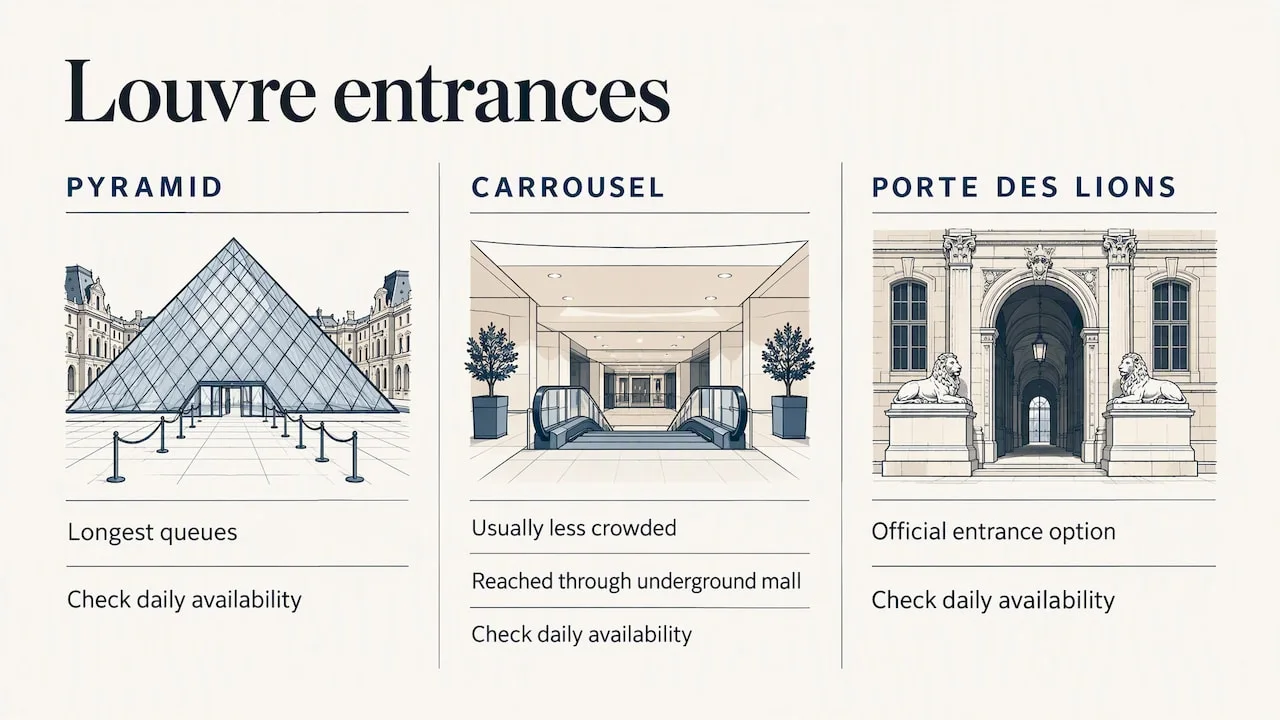
The Pyramid is the entrance everyone photographs, so it is where the longest queues form. VisitParisRegion suggests the Carrousel du Louvre entrance, reached through the underground shopping mall, which is usually less crowded. The Porte des Lions entrance is another official option. Which entrances are open on a given day can vary, so check your ticket confirmation and the museum’s visit page.
A useful habit is to check live queue data before you leave your hotel. The museum points visitors to the Affluences platform at affluences.com/louvre for real-time waiting times, according to its guidance on the best time to visit. If the Pyramid line looks long, walk to the Carrousel.
Official site or third-party reseller
You will find the Louvre sold by many websites: marketplaces, tour platforms and pages that look official. They fall into three types, and it helps to know which you are looking at.
- The official ticketing service. It sells the standard ticket at face value, and you can add official tours and audio guides during checkout.
- Bundles from tour operators. These pair entry with a guide, a meeting point outside the museum or a themed route. They can be good value if the guide is the point, but you are paying for the service, not for a faster door.
- Mirror sites and street sellers. The official ticketing page carries a prominent fraud warning about the rise in mirror sites, and says tickets sold outside the official channel may lead to denied entry.
Our rule is simple. If you only want to get in, buy from the museum. If you want a person, a route and a story, buy a tour deliberately, and read exactly what the price includes: whether the museum entry ticket is bundled in, how long the guide stays with you and how big the group is.
Guided tours and audio guides
A guided visit is not admission. It is a separate booking, made alongside your ticket or added during checkout. The museum offers its own guided programs, and the Welcome to the Louvre tour is the classic first-visit option, with an average duration of 1 hour 30 minutes. Other official formats include “Another Louvre,” an alternative route, and a family tour for children.
Here is how to choose:
- First visit, short on time: an official classic tour gives you a spine for the day. You can wander afterward with a clearer sense of the building.
- Second visit, or you have strong interests: pick one department, such as Egyptian antiquities or the medieval Louvre, and go alone with a plan.
- Traveling with children: the family format is designed around their pace.
- You want the Mona Lisa and little else: you do not need a tour. Book a morning slot and go straight to the Denon wing.
The tour covers a fraction of the collection. The museum holds more than 35,000 works on display, so no 90-minute program can be comprehensive, and that is fine. A guide shows you how to look, and the rest is yours.
Groups and private visits
If you are traveling with six or more people, or hiring a certified guide for a private party, the rules change. According to the museum’s group visit page, reservation in advance is required for all group tours, and groups without one are not admitted to the galleries. The published figures are:
| Item | Cost |
|---|---|
| Ticket per group participant | €28 |
| Reservation fee, small group (1 to 6 people) | €20 |
| Reservation fee, large group (7 to 20 people) | €90 |
| Certified guided group tour, reservation fee | €300 |
These are the museum’s own charges. They do not include what a private guide charges for their time, and that fee varies widely by guide, language and length, so ask for it in writing before you commit. Prices here are as published when we checked, and group conditions are the part of the Louvre’s rules most likely to be revised, so confirm them on the museum’s page.
Evening hours and “night” visits
People often search for Louvre night tickets or after-hours access. The museum does not sell a separate evening ticket. What exists is an extended opening: the Louvre stays open until 9:00 PM on Wednesdays and Fridays, and you book an evening time slot with the same standard ticket.
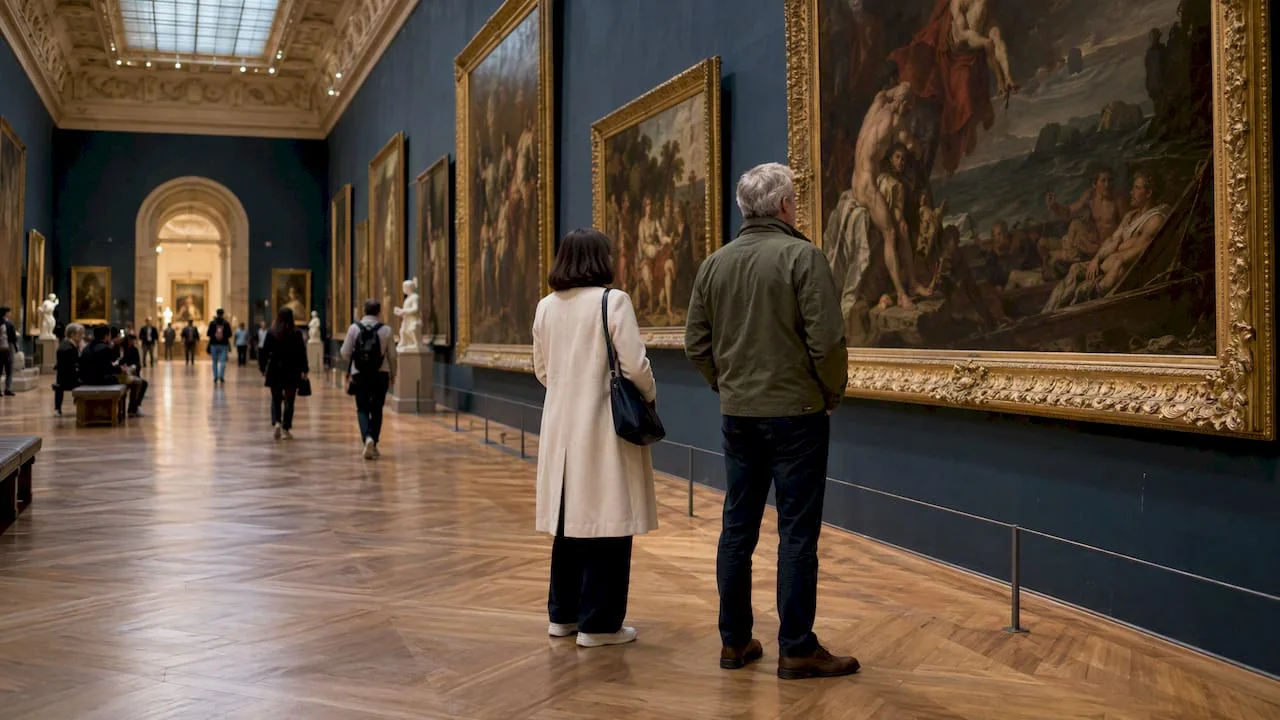
The museum recommends these evenings, from about 6:00 PM, as one of its calmer moments. The galleries feel different once the day-trip groups have left, and the Pyramid is lit.
A word of caution about “after hours” and “night at the museum” listings. If a listing promises a private, closed-door experience, it is a special arrangement, not a ticket you can click and buy on the standard site. Ask the seller who is granting access and what exactly you receive. The Louvre’s own ticketing page is the place to confirm that any event is real.
The best time to visit
The Louvre limits the number of people inside each day, but it is still busy. Two windows consistently work, according to the museum’s own advice:
- Opening time, 9:00 AM. The first hour, from 9:00 to 10:00, is the calmest of the day.
- Late-opening evenings. Wednesdays and Fridays, after 6:00 PM, until 9:00 PM.
Avoid school holiday periods if you can. Plan around Tuesdays, when the museum is closed. Weekends and the middle of the day are the heaviest.
If you want the three most famous works in a short visit, go to the Denon wing first. The museum’s visitor FAQ suggests focusing there for a 1 to 2 hour window, and says the Sully and Richelieu wings are significantly less crowded and hold major historical and decorative art collections. That is where we would send anyone who wants a quieter, deeper visit.
How much time to allow
A rushed 1 to 2 hour visit gets you the greatest hits and not much else. VisitParisRegion recommends planning 3 to 4 hours for a more meaningful visit, or a full day with breaks if you want to go further. Since admission is valid all day but exits are final, a single long visit with a lunch inside beats two shorter ones.
Sample plans:
- Two hours: Denon wing only. Winged Victory, the Mona Lisa, the Venus de Milo, then out.
- Half a day: the highlights plus one department that is not on the tourist trail, such as French sculpture or the Napoleon III apartments.
- Full day: a morning in one wing, a break, an afternoon in another, with the evening opening as an option on Wednesday or Friday.
Our perspective
We plan cultural visits for a living, and the Louvre is the place where we see the most money wasted on the wrong ticket. People overpay for “priority” products that the museum does not offer, then spend the saved effort standing in a security line anyway. The fix is dull and reliable: official ticket, sensible slot, right entrance.
Where we think spending more does help is context. A guide who knows the building’s history as a medieval fortress and royal palace, or a plan built around two or three themes instead of two hundred rooms, changes what you remember. The same logic runs through our guides to other major sites: how we handle Colosseum ticket types, the Vatican’s free and paid entries and Acropolis ticket options. Start with the official ticket, understand what it opens, and add help only where it removes a real problem.
Our view is restrained: fewer things, done with care, and one person who knows the details so you do not need to track twelve confirmations. For the Louvre, that usually means one morning visit with a clear plan, a lunch somewhere quiet in the Marais or the Tuileries, and the afternoon left empty.
— Sami
When help is worth having
Most visitors can book the Louvre on their own in ten minutes. If your trip is more complicated, with several museums, private access requests, a group, mixed ages or tight connections across more than one country, a single point of contact saves real time. Our travel design and quiet coordination service handles that planning, and our France destination page shows how we approach the country’s cultural sites. Write to us with your dates and interests, and we will tell you plainly whether you need us or just the official ticket.
Frequently asked questions
Can you buy Louvre tickets at the Louvre?
Sometimes, but do not plan on it. Time-slot booking online is the dependable way to get in, and the museum describes validated online tickets with timed entry as the way to guarantee access. If you are in Paris and have no ticket, check the official site for availability the same day before you travel across the city.
Is 2 hours at the Louvre enough?
It is enough for the highlights in the Denon wing and not much more. The museum suggests that wing for a 1 to 2 hour visit. If you care about art or history, plan 3 to 4 hours, and consider the Sully or Richelieu wings for quieter galleries.
Are Louvre tickets refundable?
Official tickets are non-refundable and non-exchangeable under the museum’s rules, so be certain of your date and time. The exception is when the museum itself closes, as with the announced October 24, 2026 strike closure, where ticket holders are automatically refunded.
Is there a Louvre ticket for night or after-hours visits?
There is no separate night ticket on the museum’s standard site. The Louvre opens late until 9:00 PM on Wednesdays and Fridays, and you book an evening slot with a regular ticket. Anything advertised as a private after-hours event should be verified with the seller and the museum before you pay.
Do I need a guided tour?
No. A tour is optional and separate from admission. It helps on a first visit or if you want historical context, and the museum’s own tours run about an hour and a half. If you prefer to explore alone, an entry ticket and a plan for one or two wings will do.
Sources
- Louvre: tickets and prices
- Louvre: hours and admission
- Louvre: rates for individual visitors, January 14, 2026
- Louvre: visitor FAQ
- Official Louvre ticketing service
- Louvre: group visits, on the day
- Louvre: Welcome to the Louvre guided tour
- Louvre: best time to visit the museum
- VisitParisRegion: 5 tips to visit the Louvre