Paris Catacombs:
A History Below the City
The ossuary is only one chapter in a longer story of Parisian quarrying, urban growth and the movement of human remains underground.
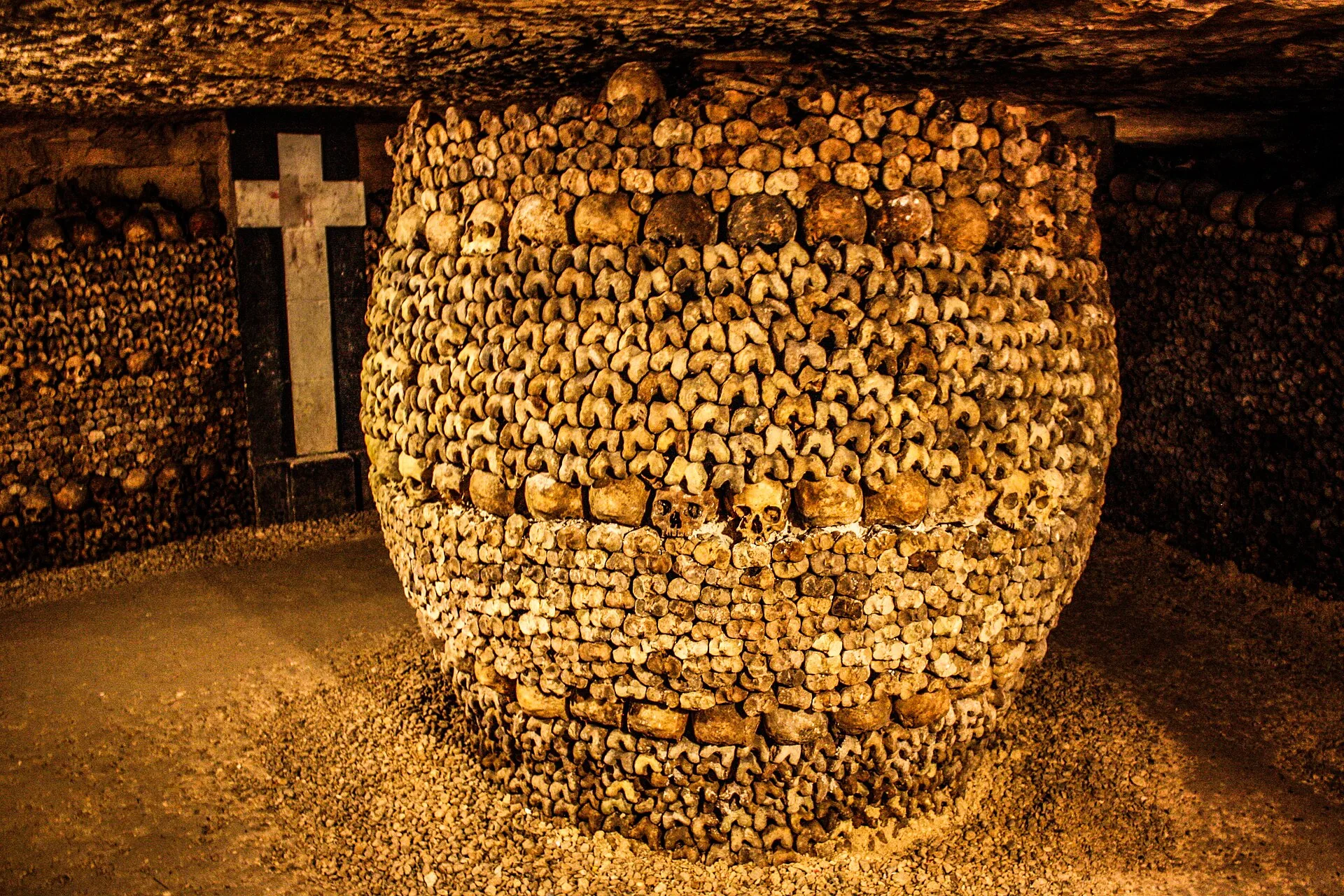
The Paris Catacombs are not simply a cemetery built underground. They occupy former limestone quarries beneath the city, later adapted to receive human remains removed from overcrowded Parisian cemeteries. Their present form joins two different histories: the making of the city above and the management of death within it.
Paris built with stone from below
For centuries, limestone was quarried beneath parts of Paris and its surroundings. The stone supplied building material as the city expanded; extraction left a complex network of galleries and voids below ground. These workings were not originally designed as public passages or as an ossuary. They were part of the infrastructure of construction, and their stability became an increasingly serious concern as the built city grew over them.
In the late eighteenth century, inspection and consolidation work helped bring order to some of the underground quarry network. The former quarries south of the city became known as the municipal ossuary, a destination for remains transferred from Paris cemeteries. The setting therefore predates its role as a place of remembrance: quarrying created the spaces, and urban authorities later repurposed them.
Why remains were moved underground
Paris’s cemeteries faced pressure from a dense, rapidly growing city. Conditions at burial grounds, especially the large central Cemetery of the Innocents, raised concerns about overcrowding and public health; the cemetery closed in 1780 after centuries of burials built up gases and odors that seeped into nearby homes.
A 1774 quarry collapse on Rue d’Enfer had already exposed how unstable the abandoned workings under Paris had become, prompting the creation of a quarry inspection department in 1777 to consolidate the tunnels before they could take on any new role.
The first transfers began with the evacuation of the Cemetery of the Innocents, carried out at night between 1785 and 1787. The site was consecrated as the municipal ossuary on April 7, 1786, marking its formal start, not its completion.
Transfers continued well past that date. Between 1787 and 1814, more parish cemeteries in central Paris were closed and emptied into the quarries, a span that runs through the French Revolution and the Reign of Terror under Robespierre. Some remains from Revolutionary-era events were added to the ossuary during those years, but Robespierre had no role in founding it; the transfers were already underway for public health reasons before the Revolution began.
The bones were arranged within the galleries over this extended period, producing the ossuary visitors encounter today in a carefully managed portion of the much larger quarry network.
From practical burial place to public site
The ossuary's purpose was practical, but its meaning changed as the underground space became accessible and organized for visitors. The galleries prompted reflection on mortality and on the city’s past, while the bones themselves became part of a deliberate commemorative landscape. This is why the Catacombs should be understood as both an engineering environment and a place of human remains—not as an ordinary tunnel attraction.
The public route is only a small, designated section of a broader underground quarry system. It follows controlled passages through the ossuary and is subject to conservation and safety rules. Visitors should stay on the authorized route and treat the site with respect.
Reading the place on a visit
Remember the sequence as you descend: stone was extracted to build Paris; the old workings required attention as the city spread; then the galleries were adapted as an ossuary when cemeteries could no longer serve the growing population. This layered history explains why the Catacombs feel at once geological, civic and memorial.
For practical details before your visit, read the route and preparation guide. If you are arranging a date, our article on the seven-day online booking window explains how to use the official calendar. More background and visitor context are collected in the Paris Catacombs guide.
Admission questions and comparisons belong on our separate Paris Catacombs ticket options page. A ticket or city pass does not change the historical meaning of the site, and pass admission should never be presumed without a valid timed reservation.
Explore the history at its source
The official site-history page provides the operator's account of the quarry and ossuary.
Official site history