Vatican Dress Code: What to Wear, Site by Site
The Vatican dress code for the Museums, Sistine Chapel and St. Peter's Basilica: what is banned, what is fine, how it is enforced and how to pack for it.
Published
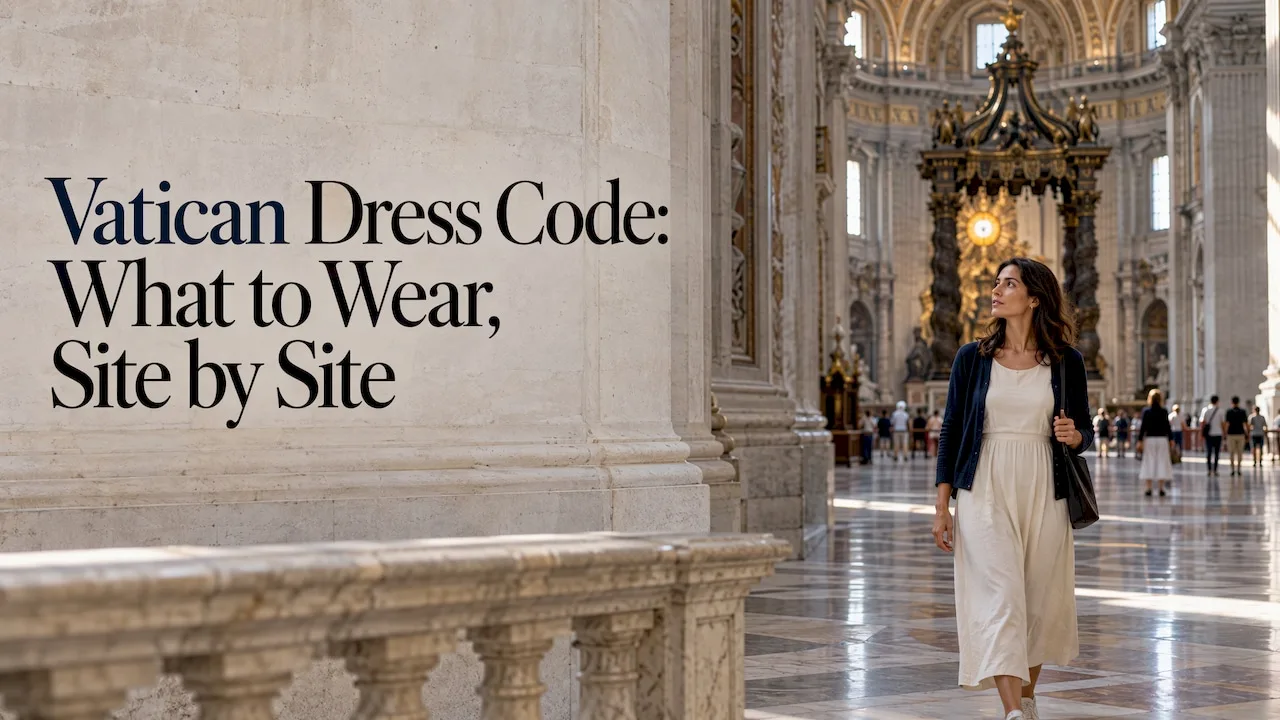
The Vatican dress code comes down to two things: cover your shoulders and cover your knees. That applies at the Vatican Museums, the Sistine Chapel, St. Peter’s Basilica and the Vatican Gardens, and it is checked at the door. Sleeveless or low-cut tops, shorts above the knee, miniskirts and hats are the items that get visitors stopped. Plan the outfit once, before the day, and the rest of the visit stays calm. Our travel office plans Vatican days around this rule, so the entry queue, the timed slot and the clothing all line up.
Key Takeaways
- Shoulders and knees covered is the safe rule everywhere in Vatican City, for men, women and children alike.
- St. Peter’s Basilica is the strictest checkpoint: men need long trousers, and women need a skirt below the knee or trousers.
- Hats come off indoors, and visible tattoos or clothing that offend Catholic morality are covered by the rule.
- Jeans, sneakers and sandals are not mentioned in the official rules. A light layer in your bag solves most problems.
- A visitor turned away can lose a timed-entry slot, so dress for the strictest checkpoint of the day.
What the official rule says
The Vatican Museums state that entry is permitted only to appropriately dressed visitors. The same wording names the Museums, the Sistine Chapel, St. Peter’s Basilica and the Vatican Gardens. It lists what is not permitted: sleeveless and/or low-cut garments, shorts above the knee, miniskirts and hats.
The rule also covers what you display. Visible personal objects and signs, such as tattoos, that may offend Catholic morality, the Catholic religion and common decency fall under the same decorum requirement.
In plain terms:
- Tops: sleeves or a layer over the shoulders. No tank tops, spaghetti straps or strapless tops, and no deep necklines.
- Bottoms: trousers, or skirts, dresses and shorts that reach the knee or below.
- Head: no hats inside.
- Message: nothing with offensive text, symbols or imagery.
The Vatican publishes the rule in several languages, and the wording differs slightly. The English text says “shorts above the knee.” The French and German versions refer to shorts that do not cover the knees. A side-by-side comparison of the versions shows that the strictest reading requires knees covered and sleeves present. Dress to that reading and no version of the rule can trip you up.
The Museums’ own page is the place to check for any change before you travel. The rule has long been stable, and the summer heat has not softened it.
Vatican Museums and the Sistine Chapel
The Museums are a long walk through galleries, courtyards and corridors, ending in the Sistine Chapel. The dress check is part of getting in. At the ticket-verification gate there is a visual check of your clothing, and visitors turned away have, in many cases, lost their timed-entry slot.
The corridors can feel relaxed, and that is where mistakes happen. According to one guide’s account of enforcement, the written rule is the same at the Museums and the Basilica, but the Sistine Chapel is where the Museums enforce it hardest. Visitors who shed a layer in a warm gallery can be stopped at the chapel door.
The practical lesson is to keep your layer on from the first gate to the last. Take it off only after you have left the chapel and the Basilica is behind you on your schedule.
Shorts, sleeveless tops and dresses
The official wording is clear on sleeveless and low-cut garments, shorts above the knee and miniskirts. A sundress with thin straps needs a cardigan, a shawl or a light linen shirt over it. A dress that reaches the knee or below is fine once the shoulders are covered.
Knee-length shorts sit in a gray zone. They are technically inside the rule, but enforcement is described as inconsistent. A visitor who wrote that she had covered shoulders and knees while many others had not shows the same unevenness. A sensible plan does not depend on a guard being lenient, particularly when the Basilica is next on your route. Light trousers or a long skirt are the easy answer in summer, and in a building with little air conditioning they are no sacrifice.
Jeans, sneakers, sandals and logos
The official text does not mention jeans, sneakers, leggings or sandals. One local guide reports that these are fine in practice as long as the top covers the shoulders. Closed, comfortable shoes are the better choice anyway: the Museums involve several miles of walking on stone floors.
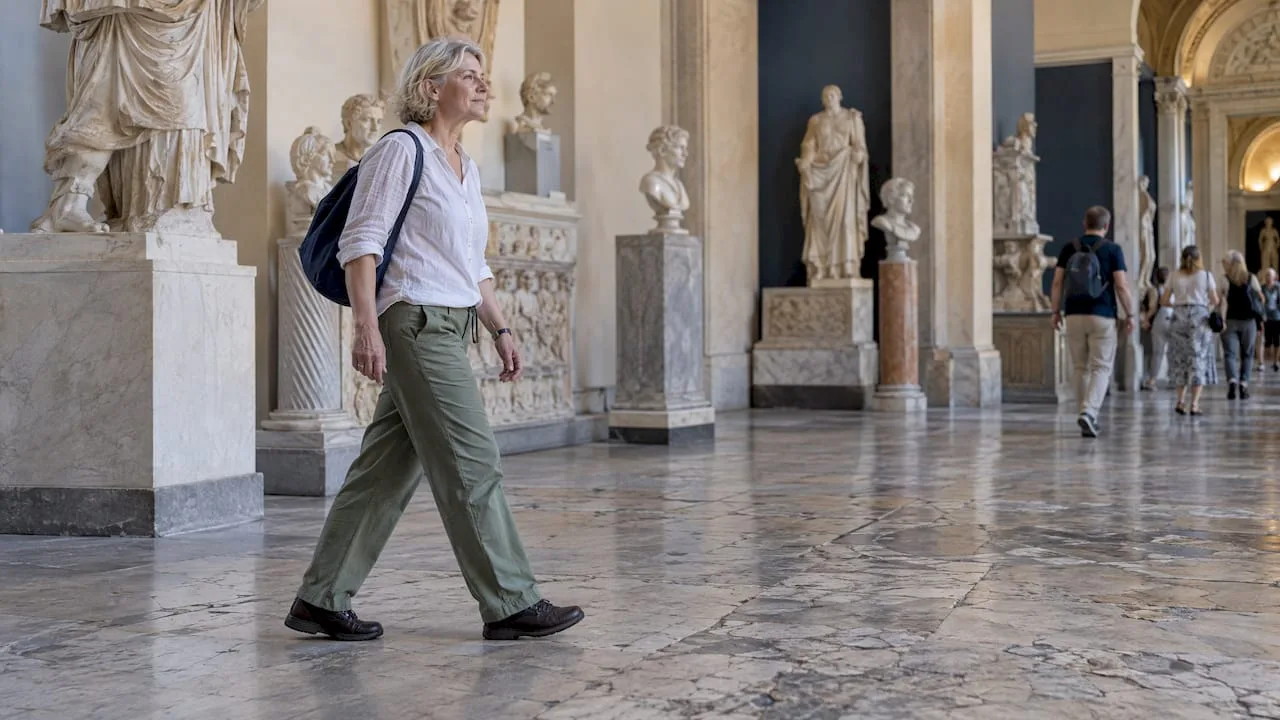
Ordinary logos and prints, including a sports team’s name, are not what the rule targets. A Basilica visitor guide says the concern is offensive text, symbols or imagery that could be disrespectful to Catholic morality, and that guards have discretion over what counts. If a shirt could be read as provocative, leave it at the hotel.
Tattoos
The official rule mentions tattoos only where they may offend Catholic morality, the Catholic religion or common decency. A standard decorative tattoo is generally not an issue. A tattoo with anti-religious or sexually explicit imagery should be covered, and a long-sleeved layer does the job.
St. Peter’s Basilica
St. Peter’s is a working church, and its rules are written in that spirit. The Basilica’s own FAQ says men are required to wear long trousers, while women must wear skirts below the knee or trousers. Shoulders must be covered for all visitors, and shorts and miniskirts are not permitted.
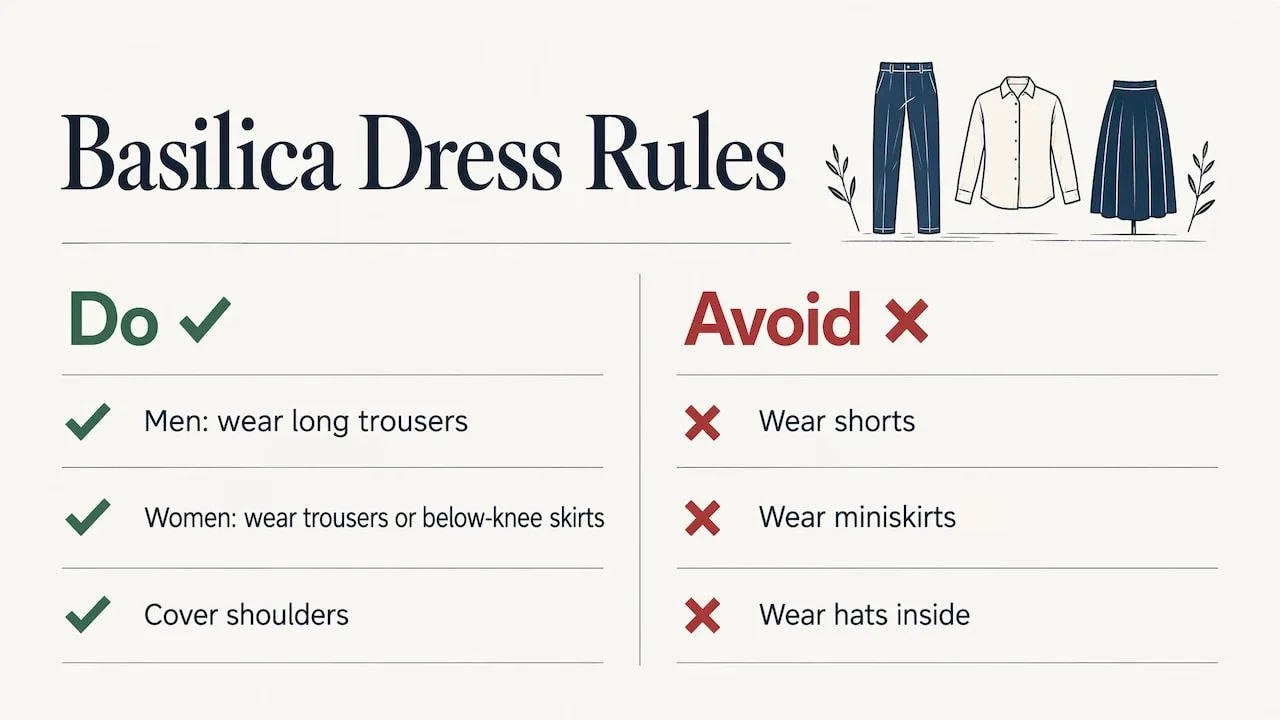
The Basilica’s rules for the common good add that hats are not allowed inside the church. Its visits page also forbids using telephones, smoking, eating and drinking, and bringing in animals or bulky objects.
Enforcement here is firm. The Italian State Police confirm that a dress code is enforced at the Basilica, and everyone heading in goes through police checks with metal detectors. According to one guide, visitors whose clothing does not comply are told why and turned away, with no partial entry or holding area.
How the Museums and the Basilica compare
| Vatican Museums and Sistine Chapel | St. Peter’s Basilica | |
|---|---|---|
| Shoulders | Covered; no sleeveless tops | Covered for all visitors |
| Legs | No shorts above the knee, no miniskirts | Men: long trousers. Women: skirt below the knee or trousers |
| Hats | Not permitted | Not permitted inside |
| Tattoos and messages | Must not offend Catholic morality | Same decorum standard |
| Where the check happens | Ticket gate, and firmly at the Sistine Chapel | At the entrance, with security screening |
If your day includes both, which is the usual plan, dress for the Basilica. Men should wear long trousers, and everyone should carry a layer for the shoulders. That outfit is accepted at every Vatican checkpoint.
What happens if your outfit does not pass
There is no appeals desk and no rental stand to rely on. Reports from the Museums say a ticket cannot be refunded if you are turned away for clothing. The rule is applied the same way to tour groups, individual travelers, children and dignitaries, according to the same Rome-based guide, which also notes that the rule is unchanged in July and August.
Some visitors report leniency, for example officials making an exception for shorts in extreme heat, as Islands.com notes. The same piece also mentions a guard making two young visitors cover their shoulders. Nobody can plan around a guard’s mood. Treat the written rule as the rule.
The hat rule has deep roots. Islands.com traces it to the 1917 Code of Canon Law, which kept men from wearing hats in church. A cap is fine in the queue, but it comes off before you enter.
What to pack: outfits that work
The easiest approach is a base outfit plus one layer, chosen for the heat and the walking.
For women:
- A top with sleeves, or a sleeveless top with a light shirt, cardigan or large scarf in your bag.
- Light trousers, a midi skirt or a dress reaching below the knee.
- Closed shoes or comfortable sandals.
For men:
- A polo, button-down or T-shirt with sleeves.
- Long, lightweight trousers such as linen or chino. These are the ones the Basilica requires.
- Comfortable walking shoes.
For children: the same rule applies to them. Light long trousers and a T-shirt with sleeves cover it.
A thin long-sleeved shirt or large scarf weighs almost nothing. One guide advises putting it on before you enter and keeping it on inside. If your plan is to carry it for the walk between the Museums and the Basilica, remember the corridors are where people let their guard down. Put it on at the door and leave it on.
A day at the Vatican is also a day of security lines and long galleries, so a small bag, a refillable bottle for outside and a light fabric that breathes make more difference than any fashion choice.
Where the dress code fits into a well-planned Vatican day
The clothing is the easy part. What makes a Vatican visit go well is the sequence: which entry, which time slot, how long the Museums take, and when to be at the Basilica. A rejected outfit costs more when your slot is fixed. A morning slot in August with a long walk to the Basilica afterward means a layer you can live with for hours.
Our guide on Vatican tickets, what is free, what costs extra and when to get help walks through the entry side of the day. If Rome is one stop in a longer trip, our Italy page shows how we approach the country.
Our view on dressing for the Vatican
We think of the dress code as the smallest item on the Vatican checklist and the one that is easiest to get right in advance. The Vatican is a place of worship first, and the rule asks something modest of a visitor: shoulders and knees covered, hats off.
What we care about is that nothing small gets in the way of what you came for. When we design a trip, we want Michelangelo’s ceiling to be the thing you remember, not a gate conversation. So we plan around the strictest checkpoint of the day, the Basilica, and treat that as the standard for the whole outfit.
The same thinking applies to the rest of a visit to a historic site: a single, well-judged plan, quiet coordination behind it, and a traveler who arrives dressed, on time and unhurried. Details like this are where a bespoke itinerary earns its keep.
Sam
Plan the whole Vatican visit with us
If you want the clothing, the entry and the timing settled for you, our travel design service builds the itinerary around your pace and interests, and our quiet coordination keeps a single point of contact for the complex parts of the trip. We design cultural and historical visits to landmarks with attention to access and detail.

Start a conversation with our private travel office through Noble Voyages, and tell us the dates and the sites you want to see.
FAQ
Can I wear shorts at the Vatican?
Officially, shorts above the knee are not permitted at the Museums, the Sistine Chapel or the Basilica. At St. Peter’s Basilica, shorts are not permitted and men must wear long trousers. Knee-length shorts are inconsistently enforced at the Museums, so lightweight long trousers are the reliable choice.
Can I wear sneakers or sandals to the Vatican?
The official rules do not mention footwear. Sneakers and sandals are reported to be fine in practice as long as your shoulders and knees are covered. Comfortable closed shoes suit the long walk through the Museums best.
Can I show tattoos at the Vatican?
The Vatican Museums’ rule applies to tattoos that may offend Catholic morality or common decency. A standard decorative tattoo is generally not a problem. If yours carries offensive or explicit imagery, cover it with a sleeve or trousers.
Do I have to cover my shoulders in St. Peter’s Basilica?
Yes. The Basilica’s official FAQ says shoulders must be covered for all visitors. Bring a scarf or light shirt if your top is sleeveless, and keep it on for the whole visit.
Are hats allowed?
No. Hats are not permitted inside the Museums or the Basilica. You can wear a cap in the queue outside, then take it off before you go in.
Sources
- Useful information for visitors, Vatican Museums
- What clothing is required? St. Peter’s Basilica
- What is the dress code to visit Saint Peter’s Basilica?
- Rules for the common good, St. Peter’s Basilica
- Visits, St. Peter’s Basilica
- Useful information, Polizia di Stato
- Vatican dress code: the official rules, word for word
- Vatican Dress Code Rules 2026
- Vatican Dress Code 2026: Sistine Chapel and St Peter’s
- Sistine Chapel Dress Code: Jeans, Shorts, Sneakers
- St. Peter’s Basilica Dress Code: What to Wear
- 8 Vatican Rules American Tourists Break, Islands.com