Open Jaw Flights: How They Work and When to Book One
An open jaw ticket lets you fly into one city and home from another on a single fare. Learn the types, the pricing catches and how to book it.
Published
An open jaw flight is a single round-trip ticket where you land in one city and fly home from another, or leave from a different city than the one you return to. You cover the gap between the two points yourself, by train, car or a separate flight. The appeal is simple: you cross a country or region in one direction and never retrace your steps to the airport you arrived at.
Below, we explain the three types, how pricing really behaves, where the rules catch people out, and how to book one so you stay protected if something goes wrong.
Key takeaways
- An open jaw ticket is one round-trip fare with a gap in it. It is not two one-way tickets stapled together, and that difference decides what the airline owes you when plans change.
- There are three types: destination open jaw, origin open jaw and double open jaw.
- Open jaw fares often beat two one-ways, but not always. Run the multi-city search and compare before you commit.
- Fare rules can reject an itinerary that looks like an open jaw. Check that it prices as a single through-fare before you pay.
- The real gain is time: no backtracking, and often an extra day or more at the places you came to see.
What an open jaw ticket actually is
The name comes from how the ticket looks when you draw it on a map. Wikipedia describes an open-jaw ticket as a return ticket where the destination and/or the origin are not the same in both directions. Draw the outbound and return arcs and the missing link between them looks like an open mouth.
The stretch you do not fly is called the surface sector. Navan’s glossary explains that you complete it by train, car or other ground transport, and that the ticket is priced as a single round trip, not two separate one-ways. That pricing is the point. The airline treats your journey as one contract.
If you have ever typed three cities into a multi-city search form (home, first destination, second destination), you were building an open jaw.
The three types of open jaw
Wikipedia lists three types, and each suits a different kind of trip.
| Type | Outbound | Return | Typical use |
|---|---|---|---|
| Destination open jaw | A to B | C to A | Arrive in one city, tour overland, fly home from another |
| Origin open jaw | A to B | B to C | You start from one home airport and return to a different one |
| Double open jaw | A to B | C to D | Both ends differ, for example a move or a long one-way journey home |
Destination open jaw
This is the version most people mean. You fly from New York to Rome, travel for ten days, and fly home from Venice. The ticket is one fare, and you never double back to Rome.
The Thrifty Traveler guide gives a clean example: fly into Geneva, spend a week traveling through Switzerland, then fly home from Zurich. One airline serves both cities nonstop, which keeps the booking simple.
Origin open jaw
Here the difference sits at the start. You might drive to a nearby hub on the way out and return to a closer airport, or begin a trip from one city while finishing at another because of work or family. It is less common for leisure travel, but it is useful when your outbound and return home airports differ.
Double open jaw
Both ends differ: you fly from A to B and return from C to D. It suits a long trip that crosses a continent in one direction, such as arriving in southern Spain and leaving from northern France while starting from one US city and ending at another.
What does not count as an open jaw
Two misunderstandings come up constantly.
Switching airports in the same city. Flying into London Heathrow and out of Gatwick, or into JFK and back from Newark, feels like an open jaw. According to Simple Flying, airline systems generally treat these as one metropolitan point, so the ticket is a standard round trip. That is not a problem, just a different label.
Any multi-city booking with a gap. Not every itinerary with a surface gap qualifies. Formal fare construction applies routing conditions, and an itinerary that does not meet them can be priced as separate one-way fares. IATA’s published fare construction materials show that open jaw combinations are restricted in certain fare categories, which is why the ticket price you see can change when you alter a single city.
The practical lesson is to look at the total fare and the fare breakdown, not just the route on the screen.
Do open jaw flights cost more or less?
They often cost about the same as a standard round trip to the first city, and frequently less than buying two one-ways. Simple Flying’s guide says they can save time and money. But there is no formula behind that. Fares depend on how an airline prices each city pair, so a route that is cheap in one direction can be expensive in another.
The Thrifty Traveler example shows how this plays out with miles: a Delta SkyMiles deal priced a multi-city trip to Australia, into Melbourne and out of Sydney, at the same 40,000 SkyMiles round trip as flying in and out of a single city. That kind of parity is common, but it is a deal, not a promise.
Here is a sensible way to test the price:
- Search a standard round trip to your first city and note the fare.
- Search the same dates as a multi-city trip with your real return city.
- Search two one-way tickets separately.
- Add the cost and time of the ground leg, whether a rail pass, a rental car with a one-way drop fee, or a short domestic flight.
- Choose on total cost and total hours, not only the headline fare.
A one-way car drop fee can erase the savings. A high-speed train between two European cities often will not.
The hidden value: time
Money is the argument people lead with, yet for most travelers the more important benefit is time. Without an open jaw, a trip through a country is a loop: arrive, travel out, travel back, fly home. With one, the trip is a line. That can hand you an extra day or more of exploration, a point Navan makes about avoiding backtracking.
Think about three examples.
- Italy. Arrive in Milan, move through Verona, Florence and Rome by rail, and fly home from Rome. You skip a day on the train back north.
- Spain. Land in Barcelona, travel south through Valencia to Andalusia, and leave from Seville or Málaga.
- France. Begin in Paris, finish in Nice or Marseille after traveling through the regions, and avoid a return to Paris just to board your flight.
These are illustrative routings, not packages. Check that your chosen airline actually flies both city pairs on your dates.
Why a single ticket matters when plans change
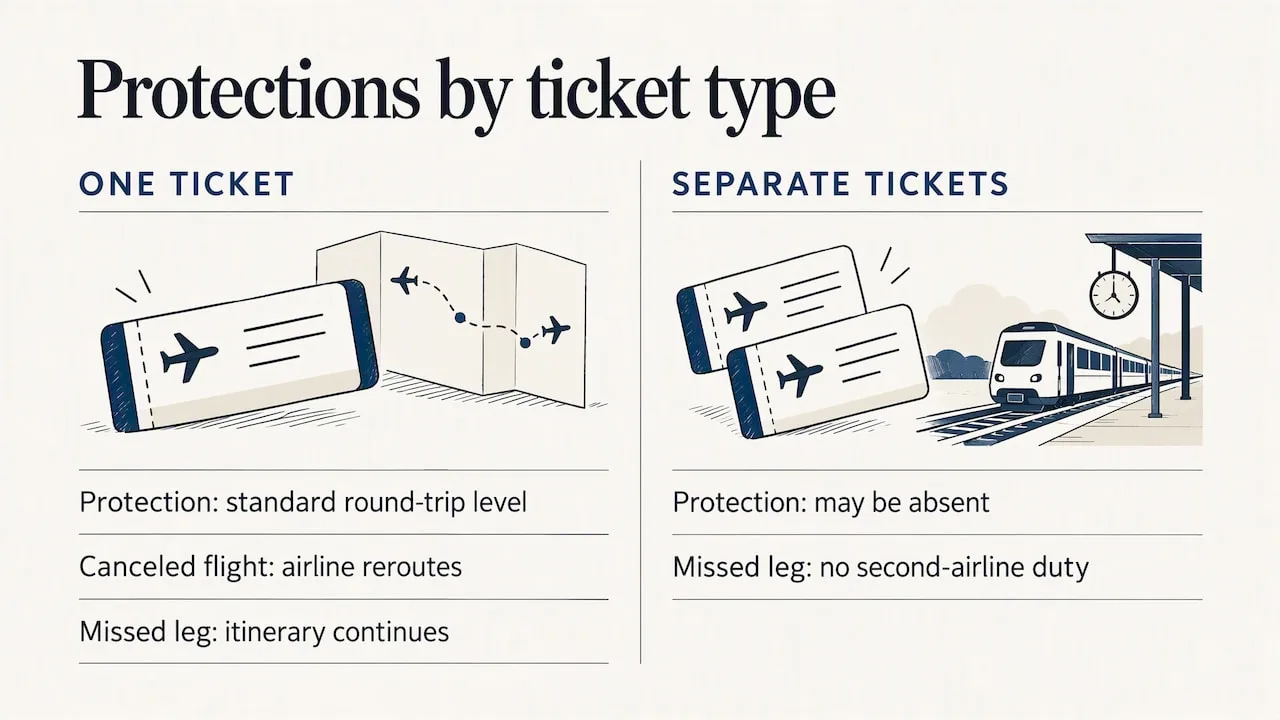
This is the part most guides bury. If you book your trip as separate one-way segments, Simple Flying notes that the airline may not provide protection, rebooking or assistance when one leg is delayed or disrupted. A true open jaw ticket carries the same protections as a standard round trip, because it is one booking with one carrier or one itinerary.
Imagine your outbound flight is canceled. On one ticket, the airline is responsible for getting you to your destination and the rest of your itinerary follows. On two unrelated tickets, the second airline owes you nothing for a missed departure caused by the first. For anyone with a hotel, a private tour or a timed entry slot already paid for, that is a serious risk.
The ground leg is different. Because you arrange it yourself, the airline will not protect it. Leave a buffer on the day you travel back toward the departure airport, particularly if the surface sector involves a train or a long drive.
How to book an open jaw flight
There is no special website. An open jaw is a regular ticket type, and any major booking engine or airline site can build it.
- Use the multi-city tool. Enter your home airport as the first departure, your arrival city as the first destination, then your departure city as the second leg’s origin, ending at home.
- Pick flights with the same carrier or alliance where possible. It tends to keep pricing as a single fare and makes disruptions easier to manage.
- Check the fare breakdown. Look for a single total for the full trip, not separate line items per leg.
- Compare fare classes. Some low-cost fare types limit changes. If your route has long overland stretches, flexibility is worth paying for.
- Check loyalty rules. Award tickets and miles programs apply their own routing rules. Air Canada’s Aeroplan policy is one example of a program that publishes its own conditions for reward flights. Read your program’s policy before you plan around a stopover or open jaw.
- Book the ground leg afterward. Reserve trains and cars once the flights are ticketed, not before.
If you are building a more complicated trip, such as several countries, private access or timed entries, the order of booking matters. Fix the flights first, then the entries tied to dates.
When an open jaw is the wrong choice
Skip it when:
- The surface sector is long and awkward. A cheap open jaw fare loses its appeal when the overland leg takes a full day.
- You are staying in one base. A standard round trip is simpler and usually cheaper.
- The fare is clearly higher and no ground cost makes up the difference.
- Your itinerary does not price as a through-fare, so the savings and protections disappear.
- You need rigid cancellation terms and the open jaw fare class is restrictive.
One more point: a multi-city trip with several stops may be cheaper booked as an open jaw plus a low-cost domestic or regional flight. Mixing is fine, as long as the long-haul flights are on one ticket.
Before you go: paperwork and details
Open jaw trips cross more borders and entry points than a simple round trip, so the details multiply. Confirm that your passport has the validity each country requires, and that any visa or authorization covers entry in the first city and exit from the last. If you need a compliant photo for a passport renewal or an application, online passport photo preparation is a quick way to get one reviewed against official requirements before you submit it. For anything involving entry rules, rely on the official government page of the country you are visiting, as they change.
Our perspective: plan the line, not the loop
We design trips around cultural and historical places, and in our experience the open jaw is one of the quietest improvements you can make to an itinerary. A trip that travels in a line lets each stop breathe. You are not rushing the last day toward an airport you flew into a week ago.
But we also do not treat it as a trick. Treat the flight as the frame, not the purpose. Start from what you want to see, how long you want to stay in each place, and what access needs arranging in advance. Then ask which cities make the most natural entry and exit points. A route like Rome in, Venice out is a different trip than Milan in, Naples out, and the flight prices should follow the route, not dictate it.
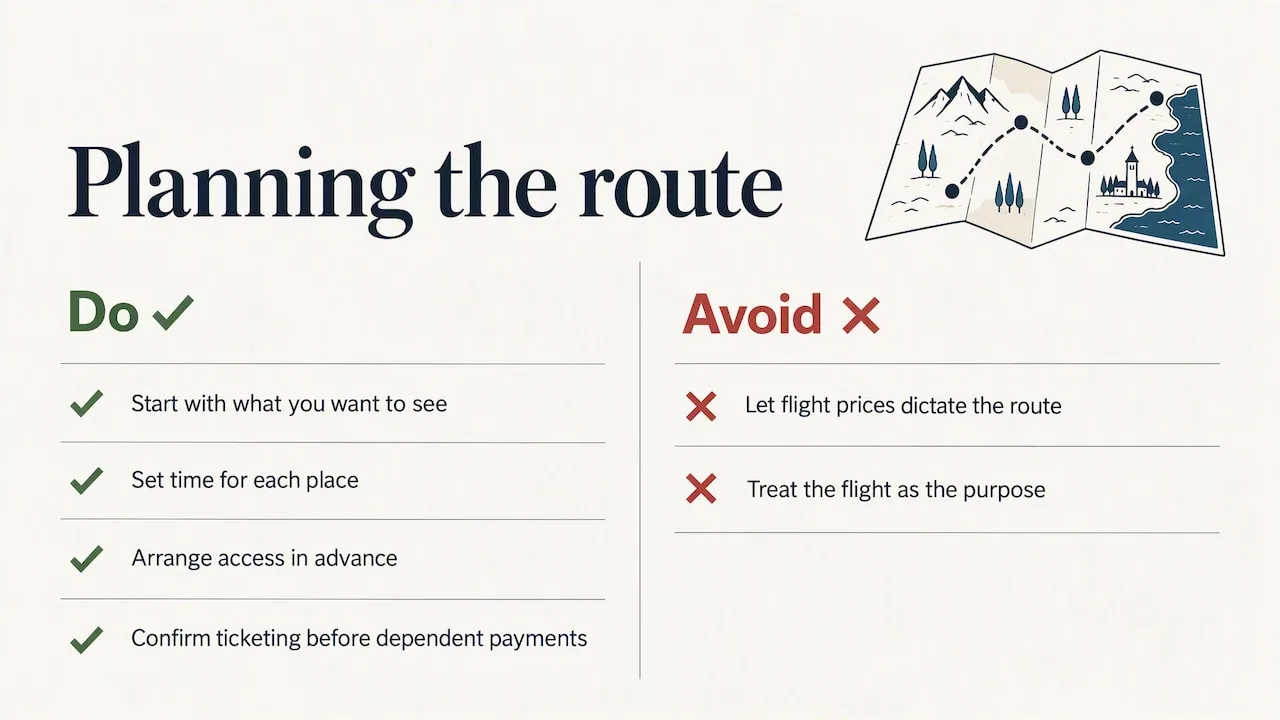
What we watch for with complex plans is the join between systems: a flight ticket, a rail booking and a timed private entry, each with its own rules. The through-fare question matters most there, because a ticket that quietly reprices as separate legs changes what happens in a disruption. That is why we confirm how an itinerary is ticketed before anything dependent on it is paid for.
Someone coordinating the pieces, even quietly, saves more than a few dollars. It saves the afternoon you would have spent at a rail station reworking a missed connection.
— Sami
Planning a trip that crosses a country
If your open jaw is part of a larger journey, we can help with the rest: the route, the order of stops, and the access that makes each place worth the visit. Our travel design and quiet coordination services are built for trips with several moving parts. You can start from our home page to reach our private travel office, or explore destination pages for Italy, Spain and France, three countries where entering in one city and leaving from another works especially well.
FAQ
What does open jaw flight mean?
It means a return ticket where the cities at the two ends are not the same in both directions. You arrive in one city and depart from another, or depart from one home airport and return to a different one. The Cambridge Dictionary defines it as flying to one airport and returning from a different one.
Do open-jaw flights cost more?
Not necessarily. They often cost about the same as a round trip and can beat two separate one-way tickets, but there is no guarantee. Fares depend on how the airline prices each city pair, so compare a round trip, a multi-city search and two one-ways for your exact dates.
Can you give an example of an open jaw flight?
A traveler flies from Chicago to Geneva, travels through Switzerland for a week by train, and flies home from Zurich. This is the simple example Thrifty Traveler uses. The week of travel between the two airports is the surface sector.
Is flying into one London airport and out of another an open jaw?
Usually not. Airline systems typically treat airports in the same metropolitan area as one point, so that kind of change is priced as a standard round trip. It is still a convenient option, just not a true open jaw.
Are open jaw tickets protected if my flight is delayed?
Yes, when booked as one ticket. A single open jaw ticket gives the same protections as a standard round trip, while separate one-way tickets may leave you without rebooking help. The ground leg between the two cities is not covered, so leave a buffer before your flight home.
Sources
- Open-jaw ticket, Wikipedia
- What Is an Open Jaw Flight, Navan
- What Are Open Jaw Flights & How Do You Book One, Simple Flying
- Simple Flying
- IATA fare construction presentation
- How to Book Open-Jaw or Multi-City Flights, Thrifty Traveler
- Aeroplan Flight Reward Policy, Air Canada
- Open-jaw definition, Cambridge Dictionary