Fast Track vs Priority: What Each Really Gets You
Fast track vs priority at the airport: what each one covers, who sells it, what it costs, and when it is worth paying for on a complex trip.
Published
Fast track is a shorter lane through one checkpoint, usually security and sometimes passport control. “Priority” is a broader word. It can mean priority boarding, priority check-in, or a full status package from an airline alliance. Fast track shortens a line, priority changes your place in an order, and neither one removes the checks. If your itinerary has several flights, tight connections or timed entries to museums and monuments, the useful question is which stage of the journey is likely to cost you time. Once you know that, you can match the right service to it.
This guide explains what each term means, who sells it, what it costs in a few real examples, and how to decide. It also covers how to plan a trip so that a missed queue does not cost you a ticketed visit.
Key Takeaways
- Fast track is a dedicated lane at security or passport control. It shortens the wait but does not change the screening itself.
- Priority usually refers to what an airline sells or grants: priority check-in, boarding order, baggage handling. Airports sell fast track, airlines sell priority boarding, and the two work independently.
- Status or membership can replace a purchase. Alliance elite tiers, premium cabins and some national trusted-traveler programs include lane access at no extra charge.
- Value depends on the airport, hour and route. A paid lane pays off at busy morning peaks and on tight connections, and does much less on short queues or intra-Schengen flights.
- Complex itineraries need a plan, not one purchase. Build buffers around anything with a timed entry, and give one person the job of coordinating it.
What fast track means
At an airport, fast track is a separate, shorter lane that you pay for, or receive with a premium ticket or status. According to one airport guide, it comes in two forms: a dedicated security lane for departing passengers, and a dedicated immigration lane, usually on arrival. In both cases you still go through the checks. You only skip most of the line in front of them.
The lane is often labeled differently from place to place. Norwegian’s fast track page notes that lanes may be marked Fast Track, CPH Express, Premium Lane, Fast Lane or Priority lane depending on the airport. So the word “priority” on a sign at security often means the same thing as fast track, which is one reason the two terms get confused.
Two practical points follow from this:
- Fast track is sold by the airport or bundled with a ticket. It is attached to a place, so the same product can be excellent in one terminal and pointless in another.
- It has opening hours. A lane that closes in the evening does nothing for a late departure, so check the lane’s hours against your flight time before you buy.
What priority means, and why it is a different thing
“Priority” is used for several services that sit in different parts of the journey:
- Priority boarding is sold by the airline and decides the order in which you board at the gate. It does nothing at security.
- Priority check-in and baggage drop are airline services that give you a shorter line at the counter, and sometimes priority baggage handling.
- Alliance priority programs bundle several of these. SkyTeam’s SkyPriority offers priority check-in, baggage drop-off, boarding, transfers, baggage handling, and immigration and ticket-office lanes, plus security lanes at selected airports, at more than 950 airports worldwide. It is available to SkyTeam First and Business Class customers and Elite Plus members, and it cannot be purchased.
The difference matters at the moment of buying. If you pay an airline for priority boarding and then face a long security queue, the purchase did nothing for the queue. If you pay an airport for fast track and then board in the last group, you may find the overhead bins full. They are separate products for separate bottlenecks, and you can use either one without the other.
Escorted services are a third category
Many travelers think of a personal escort when they hear “priority”. That is a step above both fast track and priority boarding: a person meets you, walks you through check-in, controls and connections, and often handles luggage. Fast track alone has no personal service, no luggage help and no coordination if a flight is delayed. We cover what these escorted packages include and cost in our guide to VIP airport services.
Fast track vs priority at a glance
| Fast track | Priority boarding | Priority check-in / status bundle | Escorted service | |
|---|---|---|---|---|
| Where it helps | Security, sometimes passport control | Gate | Check-in, bag drop, sometimes lanes | Whole journey stage by stage |
| Who usually sells it | Airport, or airline as an add-on | Airline | Airline, or earned through status | Specialist providers |
| Skips the checks? | No | Not applicable | No | No |
| Personal assistance | No | No | No | Yes |
| Can be purchased alone | Often | Often | Often not | Yes |
The column to look at is “Where it helps”. It tells you which of your bottlenecks the product actually reaches.
What these services cost, with real examples
Prices differ widely and change often, so treat these as examples of the pattern, each tied to the date or source it comes from, and check the airport’s or airline’s own page before you buy.
- Airport-sold lanes. Torino Airport lists its Fast Track at €9, VAT included, for a single access, open daily 04:30 to 21:00. Children under 24 months travel free with an authorized adult, and children aged 2 to 12 get a 50% discount. Vilnius Airport lists €7 per single-use ticket, valid for three months, free for children under 7, and free for holders of a long list of airline statuses.
- Airline add-ons. Norwegian’s page lists Fast Track security at 17 to 18 USD when booked more than 48 hours before departure and 23 USD within 48 hours. It can be added up to 30 minutes before departure, and it is included in Flex tickets at selected airports.
- Status-based access. SkyPriority, described above, cannot be bought at all. It comes with the cabin or the elite tier.
The pattern is consistent. Booking ahead is usually cheaper than buying at the airport. Children often get a discount or a free pass. Airline status often waives the fee, and some airports limit how many passes they sell per time slot, so the lane stays fast.
The U.S. version: PreCheck, Global Entry and CLEAR
If you depart from the United States, most of the “fast track” you will meet is not a one-off purchase but a membership. According to Modern Business Travel’s 2026 comparison, CLEAR Plus runs at more than 60 U.S. airports at $199 a year for individuals, $109 per additional adult, and free for children under 18. The same page says Global Entry costs $120 for five years, a fee raised from $100 in October 2024, and that it includes TSA PreCheck at no extra cost.
These are not the same product, which is the whole fast-track-versus-priority confusion again in a different form:
- TSA PreCheck gives you a lighter screening lane.
- Global Entry includes PreCheck and adds expedited customs on return, which makes it the logical choice for anyone flying internationally. The same guide frames it as the smarter investment over standalone PreCheck if you fly abroad at least once in five years.
- CLEAR Plus speeds up identity verification. It skips the ID line, not the physical screening.
Fees and the number of airports change, so confirm them with the program before you apply. The point for this guide is that for U.S. departures, membership often does the job a paid fast-track lane does elsewhere.
When paying for fast track is worth it
The honest test is the cost of being late against the cost of the lane. Fast track tends to earn its price in these situations, according to the airport guide cited above:
- You depart during a busy morning peak, when security queues build.
- You arrive on a long-haul flight at a time when immigration queues are long, and the airport sells an arrivals lane.
It does less in other cases: the queue at your hour is short, you qualify for an automated border gate, or the lane’s opening hours do not match your flight.
Our own additions, from the logic of itinerary planning rather than any airport statistic:
- A tight connection or a strict check-in cutoff. A shorter security line reduces risk on the part of the journey you cannot control.
- Family travel. Many airports discount or waive the lane for young children, as the Torino and Vilnius examples show, which can make it cheap for a family.
- Intra-Schengen flights. Within the Schengen area there is usually no passport control between member states, so an immigration-focused product has little to offer on those routes. Check whether your flight is Schengen or non-Schengen, and which terminal it uses, before you book.
A worked example
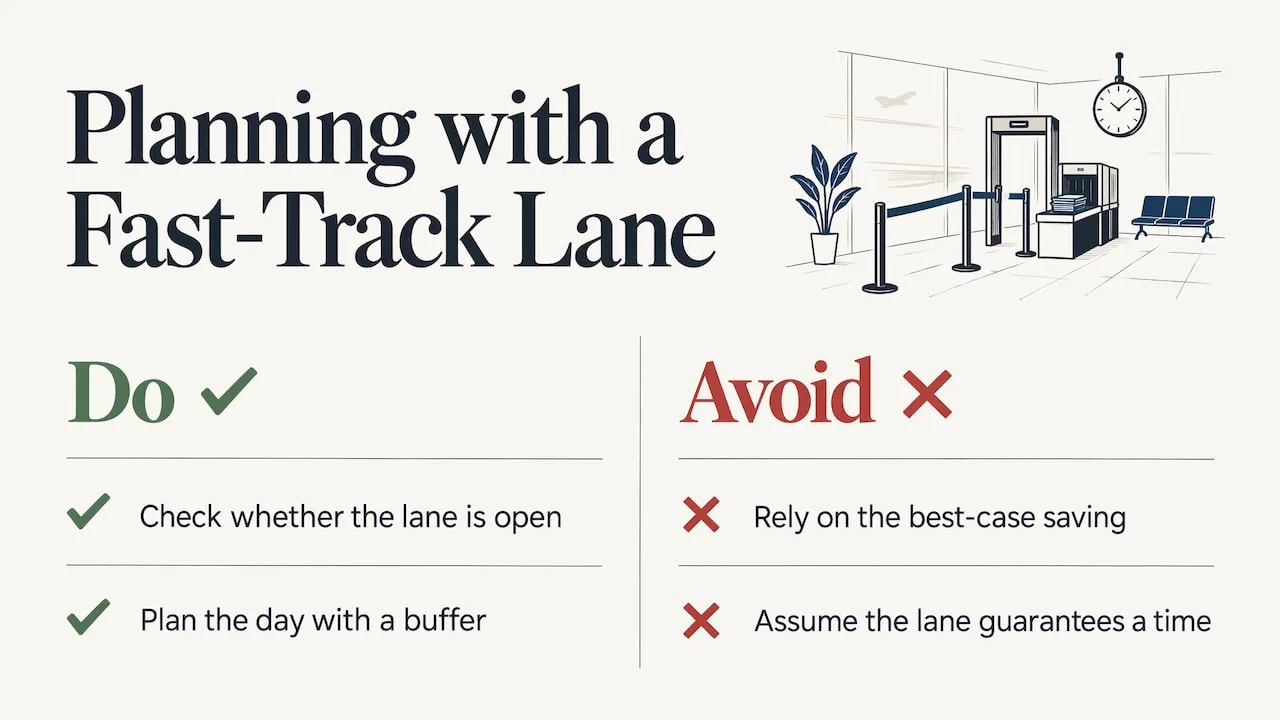
Suppose you fly out of a European airport at 07:00 with a 10:30 timed entry booked at a museum two hours away by train from your arrival airport. A €9 lane that saves you 20 minutes at security is cheap insurance, but only if the lane is open at that hour. Torino’s, for example, opens at 04:30. The lane still does not guarantee a time: the airport can still require additional checks, and a lane can still back up at peak times. The saving is real but variable, so you plan the day with a buffer, not with the lane’s best-case time.
What fast track does not promise
This is where travelers get disappointed:
- No guaranteed wait time. Airports aim to process fast-track passengers quickly, but few promise a maximum wait.
- Identical screening rules. Liquids, laptops and shoes follow the same rules as the standard lane, unless the airport has installed newer scanners. Torino’s 3D X-ray lane, for instance, lets passengers keep liquids, tablets, laptops and smartphones in hand luggage, though officers can still require additional checks.
- No help if things go wrong. A delayed inbound flight, a gate change or a missed connection is outside what a lane does.
Those gaps are the reason complex itineraries need coordination rather than a single purchase.
Fast track and priority on a complex itinerary
A single flight has one security checkpoint. A trip that includes three cities, a private museum hour, a ferry and a dinner reservation has many. For discerning travelers, the real cost of a queue is rarely the minutes. It is the missed slot that cannot be moved: a timed entry at a monument, a guide who has to start on time, a restaurant table held for an hour.
A sound approach looks like this:
- List the fixed points. Timed entries, guided visits, train departures and flights are the items that cannot slide.
- Find the bottleneck before each one. It might be security, passport control, a baggage hall or a transfer. Match the product to that bottleneck: a lane for security, an arrivals lane for immigration, status or membership if you fly often.
- Check the airport, not the brand. Opening hours, terminals and eligibility differ even within one alliance. For example, at Frankfurt, a guide to the airport’s lanes notes that Star Alliance Gold Track priority security is in Terminal 1 only, while SkyTeam’s SkyPriority covers Terminal 3.
- Plan the ground leg. The lane saves minutes inside the terminal, and the journey to and from it can lose them. If you land in New York, our readers can compare JFK, LaGuardia and Newark transfer times to choose the arrival airport that fits their hotel.
- For groups, assign a lead. Family reunions, tours and multi-generational trips benefit from a written group airport arrival plan, with one person responsible for timings.
Our perspective
Travelers often ask us which lane to buy. The better question is what the day is built around. A fast-track pass is a good tool, and it is one tool. When a trip has several moving parts, such as a flight, a transfer, a private visit and a dinner, the thing that protects the day is a single person who holds the whole schedule and notices early when one piece slips.
That is how we approach travel design. We plan the itinerary around the fixed points first, then work backward, leaving room where it matters. Quiet coordination means you deal with one point of contact rather than a different provider for every leg, and the arrangements for each stop fit together without you having to manage them.
For travelers who care about cultural and historic sites, this is where the value lies. A private hour at a landmark is worth more when you arrive calm and on time. Lanes and priority services are part of getting you there, and we would rather they be chosen deliberately than bought out of worry.
Sam
How Noble Voyages can help
If your plans involve more than a single flight, our travel design service builds the itinerary around your fixed points, and quiet coordination gives you one trusted contact for the details. We design journeys for travelers who want meaningful visits at historically significant sites, with expert guidance and, where we arrange it, private access.
Tell us where you want to go and when, and we will start from the parts of the trip that cannot move. You can reach us through Noble Voyages. If a particular destination is already on your mind, our pages on Italy, Spain and the UAE are a good place to see how we approach it.
FAQ
Is fast track the same as priority boarding?
No. Fast track is a dedicated lane at security or passport control, usually sold by the airport. Priority boarding is an airline service that sets your boarding order at the gate. You can buy or hold one without the other.
What does “fast track” mean on a ticket or a sign?
It means a separate, shorter lane for a particular checkpoint, usually security, sometimes passport control. You still go through the same checks. Signs may say Fast Track, Fast Lane, Premium Lane or Priority lane, and they mostly mean the same thing.
Can I buy priority access, or is it earned?
Both exist. Many airports and some airlines sell lane access as a one-off, often cheaper if you book ahead. Alliance programs such as SkyPriority cannot be purchased and come with premium cabins or elite status.
Is a paid fast-track lane worth it for families?
Often it is cheaper than expected, because airports commonly discount or waive the fee for young children. Torino and Vilnius both do, with different age limits. Check the age rule and lane hours on the airport’s own page before booking.
What is the U.S. equivalent of fast track?
Mostly memberships. TSA PreCheck gives a lighter screening lane, Global Entry includes PreCheck and adds expedited customs, and CLEAR Plus speeds up identity checks. Fees and airport coverage change, so confirm them with each program.
Sources
- Fast track at the airport: security and passport control
- SkyPriority, SkyTeam
- Fast Track Through Security, Norwegian
- Torino Airport Fast Track
- Fast Track service, Vilnius Airport
- Global Entry vs CLEAR vs TSA PreCheck (2026), Modern Business Travel
- Frankfurt Airport Fast Lane 2026 guide
- JFK vs LaGuardia vs Newark transfers
- Group airport arrival coordination